
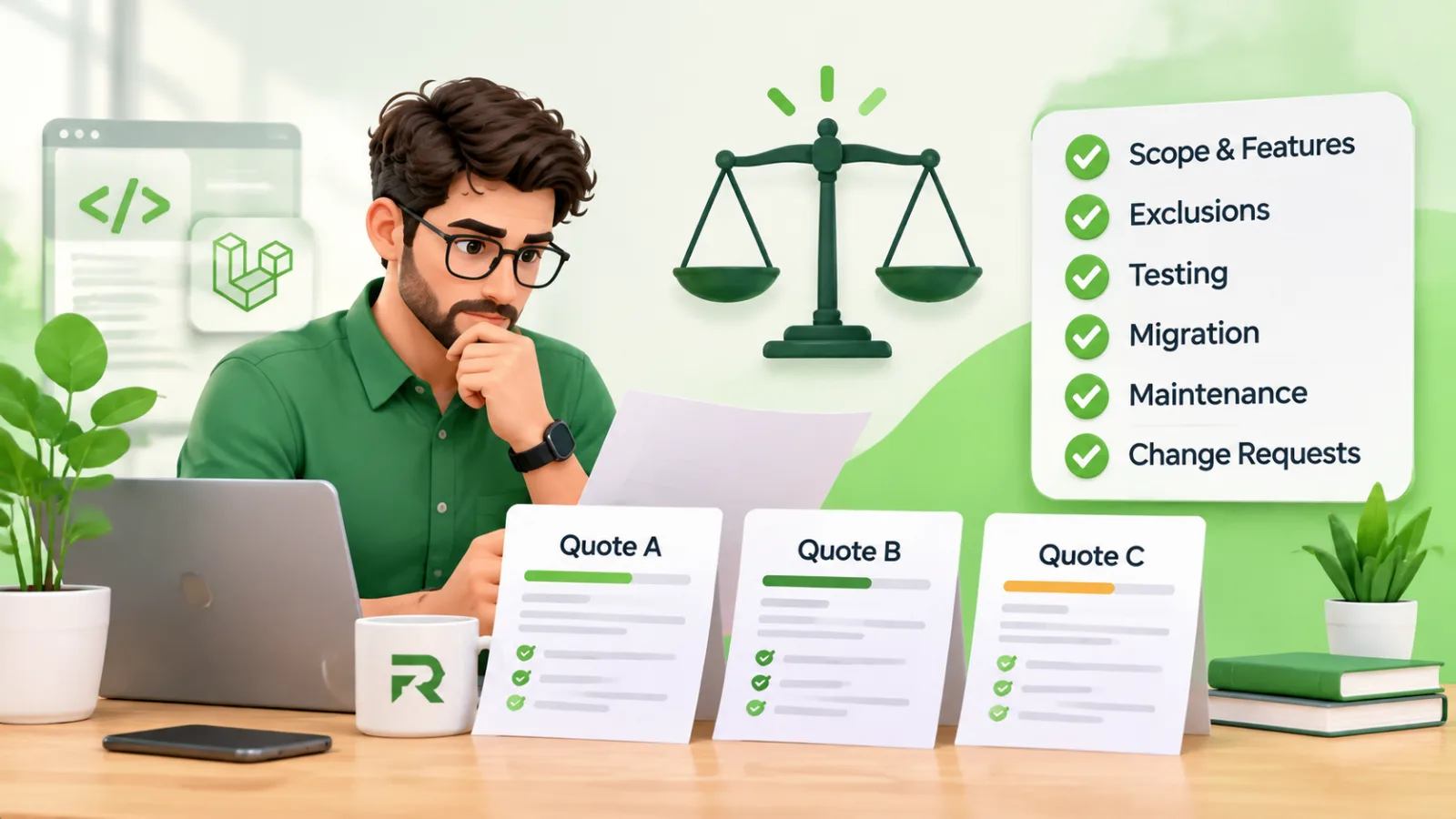
Three quotes arrive for the same project. One is much lower than the others, one is vague, and one is long and detailed. If you are a small business owner, it is tempting to pick the lowest number and move on. This guide shows how to compare software development quotes so that you are judging the same work each time, not three different interpretations of it.
The goal is not to find the most expensive or the cheapest vendor. It is to find the proposal whose scope, assumptions and risks you understand. For background on what drives price, see our custom software cost guide.
Start With Your Own Brief
You cannot compare quotes fairly if each vendor was briefed differently. Before you collect proposals, write down the problem, the users, the key workflows and the systems you already use. A short software requirements document is enough.
Send the same brief to every vendor and answer their questions in writing, shared with all of them. This single step removes much of the variation between quotes.
Why the Cheapest Quote May Cover Less Work
A lower price can come from real efficiency, a smaller team, or a different location. It can also come from a narrower scope that is not obvious on page one. Common ways a quote gets cheaper without getting better value:
- Testing is not mentioned, so it is not included.
- Data migration and integrations are listed as "to be discussed."
- Design is limited to templates rather than your workflows.
- Deployment, documentation and handover are left out.
- Every change after kickoff is billed as a new request.
This does not mean expensive vendors are always better. A higher quote can include padding, unneeded features or vague contingency. The only reliable test is what each price actually covers. Our overview of how software projects are estimated explains why ranges differ so much.
How to Compare Software Development Quotes Line by Line
Go through each proposal using the same ten headings below. Where the quote is silent, mark the cell "not stated" rather than assuming the best.
1. Scope
Look for a list of features or user stories, not just a paragraph of description. Check which user roles are covered; our guide to planning user roles and permissions shows how much hidden work sits there. If the scope is large, ask whether a phased release makes sense, as described in reducing scope without losing purpose.
2. Assumptions
Every estimate rests on assumptions: number of screens, who supplies content, how fast you give feedback, which third-party services stay available. Good vendors write these down. If a quote has none, the price is probably more fragile than it looks.
3. Exclusions
Exclusions are the most useful part of a proposal. Look for items such as native mobile apps, admin dashboards, reporting, email templates, hosting costs and third-party licenses. A clear exclusions list is a sign of honesty, not weakness.
4. Acceptance criteria
Ask how you will know a feature is done. Strong proposals describe testable outcomes, for example what a user can do and what the system records. See these acceptance criteria examples for the level of detail to expect.
5. Integrations
Payment gateways, accounting tools, CRMs and shipping services each add work. Check which integrations are named, which API versions are used and who owns the third-party accounts. The API integration checklist lists what to confirm. It also helps to skim the vendor's web API documentation basics if you want to understand what is being connected.
6. Data migration
If you are leaving spreadsheets or an old system, migration can be a project on its own. Ask who cleans the data, how many records are expected, how many trial runs happen and what happens to data that does not fit. Our spreadsheet migration plan walks through the steps.
7. Testing
Ask what kinds of testing are included: automated tests, manual testing, browser and device checks, and user acceptance testing with you. Security matters too. A vendor that references the OWASP Top Ten risks is at least thinking in the right direction. For apps, compare against a mobile app security checklist.
8. Deployment
Who sets up servers, domains, SSL, backups and monitoring? Is there a staging environment? Are launch support and a rollback plan included? Performance expectations belong here as well, since fixing slow software later costs more than planning for it; see these ways to improve application speed.
9. Maintenance and support
Software needs updates after launch. Check whether the quote includes a warranty period for defects, and what a support agreement would cost and cover. Our guide to budgeting for maintenance helps you plan, and the maintenance agreement checklist covers response times and scope. Also confirm that you will receive source code, documentation and credentials, as in a project handover checklist.
10. Change requests
Changes will happen. What matters is how they are handled. Ask for the process: written request, impact estimate, your approval, then work. Ask whether the rate is fixed and whether small tweaks are absorbed. Fixed-price and time-and-materials models handle change differently, so understand which one you are signing.
A Copyable Comparison Table
Paste this into a spreadsheet and fill one column per vendor. Use "not stated" where the quote is silent.
- Total price and pricing model: Vendor A ___ | Vendor B ___ | Vendor C ___
- Timeline and milestones: ___ | ___ | ___
- Features and roles in scope: ___ | ___ | ___
- Written assumptions: ___ | ___ | ___
- Exclusions listed: ___ | ___ | ___
- Acceptance criteria: ___ | ___ | ___
- Integrations named: ___ | ___ | ___
- Data migration included: ___ | ___ | ___
- Testing types included: ___ | ___ | ___
- Deployment and launch support: ___ | ___ | ___
- Warranty and maintenance terms: ___ | ___ | ___
- Change request process and rate: ___ | ___ | ___
- Code ownership and handover: ___ | ___ | ___
- Team and communication: ___ | ___ | ___
Once filled in, the gaps become visible. A low quote with five "not stated" cells is not comparable to a detailed one until those cells are resolved.
Questions to Resolve Vague Estimates
When a line is unclear, send the same question to every vendor. Useful ones include:
- Which features are included, and which are explicitly not?
- What assumptions would make this price go up or down?
- How many revision rounds are included for design?
- Which third-party services are integrated, and who pays their fees?
- How will existing data be moved, and who validates it?
- What testing do you run, and what do we test before sign-off?
- What does the warranty cover, and for how long?
- How are change requests priced and approved?
- Who will work on the project, and can we meet them?
- What do we receive at the end: code, documentation, accounts?
Pay attention to how vendors answer. Direct answers with trade-offs explained are a better sign than confident replies with no detail. Our guide on choosing a software development company adds questions about team and track record.
Check the Approach, Not Only the Price
Two vendors can quote the same number and run very different projects. Ask how they plan, demo progress and handle risk. A clear development process with regular reviews usually surfaces problems sooner. For agile delivery in general, the Agile Manifesto principles are a reasonable reference point, though what matters is how the vendor applies them.
Also consider fit. A vendor experienced with small business software projects will often size and phase work differently from one used to large enterprises. And if your project is a first release, an MVP approach may make quotes easier to compare because the scope is tighter.
Common Reasons Projects Fail After a Good-Looking Quote
Most disputes trace back to unclear scope, missing acceptance criteria or unmanaged change, not to bad intent. The same patterns appear in common causes of software project failure. Settling the ten headings above before signing prevents most of them. For general guidance on software project risk, the NIST software quality resources are a useful reference.
Making the Final Decision
When the table is complete, remove price from the discussion for a moment. Which vendor understood your business best? Whose assumptions are realistic? Whose exclusions can you live with? Then adjust each quote for the gaps: if one vendor omitted migration and testing, ask for a revised quote that includes them, or estimate that work separately so the totals line up.
It also helps to compare the cost model against your plans after launch. If you expect ongoing development, a dedicated team model may suit better than repeated fixed-price projects. Our comparison of team models explains the trade-offs.
Conclusion
Fair comparison comes down to making the invisible work visible: scope, assumptions, exclusions, testing, migration, deployment, support and change. If you want a second opinion on proposals you have received, or a detailed quote built on a clear brief, talk to RuhaniSoft and we will walk through it with you.