
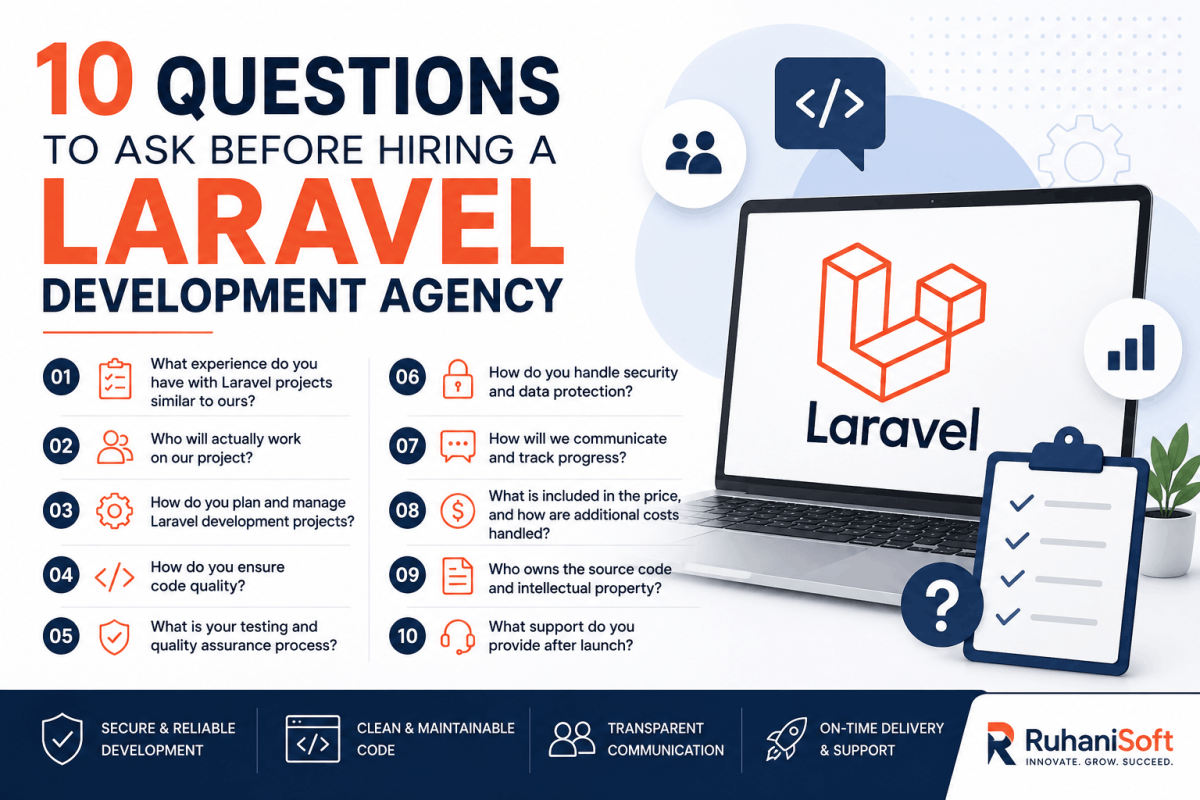
Hiring a Laravel development agency is a major decision for any startup, agency, or established business. The team you choose will influence your application’s architecture, security, performance, scalability, development cost, and long-term maintainability.
A strong Laravel agency can help you launch faster, avoid technical mistakes, and build a reliable product. The wrong agency can create poorly structured code, missed deadlines, hidden costs, security risks, and a system that becomes difficult to improve.
This is why businesses should evaluate more than portfolios and hourly rates. Before hiring a Laravel development agency, you need to understand how the team works, how it manages quality, how it communicates, and whether it can support your product after launch.
This guide covers ten important questions to ask before choosing a Laravel development partner.
Why Choosing the Right Laravel Agency Matters
Laravel is a flexible PHP framework used for SaaS platforms, marketplaces, business systems, customer portals, APIs, subscription applications, dashboards, and internal tools.
Although Laravel provides many built-in features, successful application development still requires careful architecture, secure coding, database planning, testing, deployment management, and ongoing maintenance.
Two agencies may both claim to be Laravel experts, but their development standards can be very different.
One agency may use clean architecture, code reviews, automated testing, documentation, and structured project management. Another may rely on rushed development, copied components, unclear requirements, and limited quality control.
The following questions will help you identify the difference.
1. What Experience Do You Have with Laravel Projects Similar to Ours?
The first question should focus on relevant experience, not only general years in software development.
An agency may have worked with Laravel for several years but still lack experience in your specific type of application.
For example, building a basic company website is very different from developing:
- A multi-tenant SaaS application
- A subscription billing platform
- A two-sided marketplace
- A financial management system
- A custom CRM
- A booking platform
- A high-traffic API
- A role-based business portal
Ask the agency to explain projects that involved similar users, workflows, integrations, performance requirements, or business models.
What You Should Look For
A qualified Laravel agency should be able to discuss:
- The business problem it solved
- The Laravel version and architecture used
- The main technical challenges
- The integrations involved
- The project delivery process
- The results achieved
- The lessons learned
Case studies are useful, but technical explanations are more valuable. A capable agency should be able to describe its work clearly without revealing confidential client information.
Warning Signs
- Only showing generic websites
- Avoiding technical questions
- Claiming expertise in every industry
- Providing no examples of complex Laravel applications
- Using another company’s work in its portfolio
2. Who Will Actually Work on Our Project?
Many agencies present senior developers during sales meetings but assign the project to junior developers after the contract is signed.
You should know who will be responsible for development, architecture, quality assurance, communication, and project management.
Ask for the expected team structure.
A typical Laravel project team may include:
- Laravel backend developer
- Frontend developer
- UI and UX designer
- Quality assurance engineer
- Project manager
- DevOps engineer
- Technical lead
Questions to Ask About the Team
- How many developers will work on the project?
- What is their Laravel experience?
- Will the team be dedicated or shared across projects?
- Who will review the code?
- Who will communicate with us?
- What happens if a developer becomes unavailable?
You do not necessarily need the most senior developer for every task. However, senior technical oversight is important for architecture, security, scalability, and code quality.
Why Team Transparency Matters
Knowing the team helps you evaluate whether the proposed timeline and price are realistic. It also reduces the risk of unexpected substitutions or communication gaps.
3. How Do You Plan and Manage Laravel Development Projects?
A professional Laravel development agency should have a clear delivery process.
Good development is not only about writing code. It also involves requirement analysis, estimation, sprint planning, testing, review, deployment, and reporting.
Ask the agency to explain how a project moves from the initial discussion to production release.
A Structured Process May Include
- Discovery and requirement analysis
- Technical planning
- Feature prioritization
- UI and UX design
- Database and architecture planning
- Sprint development
- Code review
- Quality assurance
- Client review
- Deployment
- Post-launch support
Ask About Project Management Tools
Reliable agencies usually use tools such as Jira, ClickUp, Trello, Linear, Asana, or similar platforms to track tasks and progress.
You should be able to see:
- Current tasks
- Completed work
- Upcoming priorities
- Reported bugs
- Blocked items
- Sprint progress
Warning Signs
- No documented requirements
- No task management system
- No milestones or sprint planning
- Unclear approval process
- No staging environment
- No regular progress reporting
4. How Do You Ensure Code Quality?
Code quality directly affects application stability, performance, security, and future development cost.
Poorly structured code may work during the first release but become difficult to maintain as new features are added.
Ask the agency about its coding standards and review process.
Strong Laravel Code Quality Practices
- Following Laravel conventions
- Using clear naming standards
- Separating business logic from controllers
- Using service classes where appropriate
- Applying repository patterns only when useful
- Avoiding duplicated code
- Using database migrations and seeders
- Reviewing pull requests
- Writing automated tests
- Maintaining technical documentation
Ask About Code Reviews
Code review should be performed by another developer or technical lead before changes are merged into the main branch.
This helps identify:
- Security vulnerabilities
- Performance problems
- Incorrect business logic
- Poor code structure
- Testing gaps
- Laravel convention violations
Ask About Development Tools
The agency may use tools such as:
- PHPStan
- Laravel Pint
- PHP CS Fixer
- PHPUnit
- Pest
- GitHub Actions
- GitLab CI
- Laravel Telescope
- Laravel Debugbar
The exact tools matter less than having a consistent and documented quality process.
5. What Is Your Testing and Quality Assurance Process?
Testing should not happen only at the end of development.
A reliable Laravel development agency should test features throughout the project.
Types of Testing May Include
- Unit testing
- Feature testing
- API testing
- Integration testing
- Browser testing
- Manual functional testing
- Performance testing
- Security testing
- Regression testing
- Cross-device testing
Questions to Ask
- Who is responsible for testing?
- Do developers test their own work?
- Is there a dedicated QA engineer?
- Are critical workflows covered by automated tests?
- How are bugs tracked?
- How is regression testing performed?
- Do you provide a staging environment?
For business-critical applications, testing should cover important processes such as authentication, payments, permissions, subscriptions, data exports, and account management.
Why Testing Matters
A lack of testing may reduce the initial development price, but it usually increases long-term costs through production bugs, customer complaints, failed releases, and repeated manual checking.
6. How Do You Handle Security and Data Protection?
Security should be discussed before development begins, not after the application is launched.
Laravel provides useful security features, but developers must still implement them correctly.
Security Areas to Discuss
- User authentication
- Role and permission management
- Input validation
- SQL injection prevention
- Cross-site scripting protection
- Cross-site request forgery protection
- Password security
- API authentication
- File upload validation
- Rate limiting
- Database access controls
- Secure environment configuration
European businesses may also need to consider GDPR requirements, data processing responsibilities, user consent, data retention, and access controls.
Ask About Access Management
The agency should explain how it handles:
- Server credentials
- Database credentials
- API keys
- Payment gateway credentials
- Cloud access
- Source code repositories
- Employee access removal
Important Contract Considerations
Depending on the project, you may need:
- A non-disclosure agreement
- A data processing agreement
- Confidentiality clauses
- Security responsibilities
- Incident reporting procedures
7. How Will We Communicate and Track Progress?
Communication is one of the most important factors in software development.
Even a technically skilled agency can fail if updates are unclear, delayed, or inconsistent.
Before signing a contract, define how communication will work.
Ask the Agency About
- Meeting frequency
- Daily or weekly updates
- Primary communication channels
- Response times
- Time zone overlap
- Escalation procedures
- Demo and review schedules
Communication tools may include Slack, Microsoft Teams, Google Meet, Zoom, email, or project management platforms.
What Good Communication Looks Like
A professional agency should provide updates that explain:
- What was completed
- What is currently being developed
- What is planned next
- What decisions are required
- What risks or blockers exist
Progress reports should be specific. Statements such as “work is ongoing” do not provide enough information.
Communication with Offshore Agencies
When hiring an offshore Laravel development agency, confirm how many working hours overlap with your local time.
A reliable offshore partner does not need to work in your exact time zone, but it should provide predictable overlap for meetings, feedback, and urgent issues.
8. What Is Included in the Price, and How Are Additional Costs Handled?
Laravel development proposals can vary significantly. A lower quote may exclude important services such as testing, deployment, project management, design, documentation, or post-launch support.
You should understand exactly what the price includes.
Ask Whether the Estimate Covers
- Requirement analysis
- UI and UX design
- Frontend development
- Laravel backend development
- API development
- Third-party integrations
- Quality assurance
- Project management
- Deployment
- Documentation
- Bug fixing
- Post-launch support
Ask About Third-Party Costs
Some costs may not be included in the development price, such as:
- Hosting
- Cloud services
- Email delivery services
- SMS providers
- Payment gateway fees
- Premium software licenses
- External APIs
- Monitoring tools
- Domain and SSL costs
Understand the Pricing Model
Common Laravel development pricing models include:
Fixed Price
A fixed price works best when the project requirements are detailed and stable.
Time and Materials
This model is more flexible for evolving products, ongoing development, and changing priorities.
Dedicated Developer or Team
You pay for reserved monthly development capacity.
Ask how scope changes are estimated and approved. Additional work should never appear as an unexpected invoice without prior discussion.
9. Who Owns the Source Code and Intellectual Property?
Source code ownership must be clearly defined before development begins.
Your agreement should state that your company owns the completed source code, project files, database structure, designs, documentation, and custom intellectual property after agreed payments are completed.
Ask Directly
- Will we own the complete source code?
- Will the repository be under our company account?
- Will we receive all design files?
- Will we own custom modules and APIs?
- Are there any licensing restrictions?
- Are third-party packages used?
- Will we receive deployment and setup documentation?
Use a Company-Controlled Repository
Whenever possible, keep the project in a GitHub, GitLab, or Bitbucket repository controlled by your company.
The agency can be given appropriate access without becoming the permanent owner of the repository.
Check Open-Source and Commercial Licenses
Laravel itself is open source, but the application may use commercial packages, templates, plugins, or services.
Ask the agency to document all external dependencies and their license requirements.
10. What Support Do You Provide After Launch?
Launching the application is not the end of the project.
Real users may discover unexpected issues. Hosting environments may require updates. External APIs may change. New security patches may be released.
You need to know what happens after deployment.
Ask About the Warranty Period
Many agencies provide a limited period for fixing bugs related to the agreed project scope.
Clarify:
- How long the warranty lasts
- What qualifies as a bug
- What is considered a new feature
- How quickly critical issues are handled
- Whether emergency support is available
Ask About Ongoing Maintenance
Laravel maintenance may include:
- Security updates
- Laravel version upgrades
- PHP version upgrades
- Server monitoring
- Database optimization
- Bug fixing
- Performance improvements
- Backup monitoring
- Feature development
- Third-party API updates
A long-term support agreement can be especially valuable for startups and businesses without an internal Laravel team.
Additional Questions Worth Asking
The ten questions above cover the most important areas, but you may also ask:
- Can you provide client references?
- How do you estimate project timelines?
- How do you manage changing requirements?
- What happens if the project is delayed?
- Do you provide technical documentation?
- How do you handle application backups?
- Can your team scale if the project grows?
- Do you provide DevOps and deployment support?
- How do you measure application performance?
- Can you work with our existing development team?
Red Flags to Watch Before Hiring a Laravel Agency
Some warning signs should not be ignored.
Unrealistically Low Estimates
A very low proposal may indicate missing requirements, junior-only staffing, limited testing, or future hidden charges.
Guaranteed Results Without Analysis
A serious agency should review requirements before guaranteeing cost, timeline, or performance.
No Written Scope
Verbal promises are not enough. Deliverables, responsibilities, pricing, and timelines should be documented.
Poor Communication During Sales
If communication is already slow or unclear before payment, it is unlikely to improve after the contract begins.
No Access to Source Code
You should not have to wait until the end of the project to see your own source code.
No Testing Process
An agency that treats testing as optional creates unnecessary business risk.
No Post-Launch Plan
Applications need ongoing maintenance. A lack of support planning can leave you without technical help after deployment.
How to Compare Laravel Development Agencies
Create a comparison table before making your final decision.
You can evaluate each agency based on:
- Relevant Laravel experience
- Technical capabilities
- Team structure
- Development process
- Communication quality
- Testing standards
- Security practices
- Pricing transparency
- Source code ownership
- Post-launch support
Do not choose based on price alone. Consider the total cost of ownership.
A slightly more expensive agency may provide better architecture, fewer bugs, faster communication, and lower long-term maintenance costs.
Should You Start with a Trial Project?
A small paid trial can reduce risk before committing to a long-term partnership.
The trial may involve:
- Building a small feature
- Fixing an existing Laravel issue
- Creating an API endpoint
- Reviewing the current codebase
- Optimizing a slow page
- Integrating a third-party service
During the trial, evaluate:
- Communication
- Code quality
- Delivery speed
- Documentation
- Problem-solving ability
- Testing discipline
A successful trial provides more reliable information than a sales presentation.
Why Businesses Choose RuhaniSoft for Laravel Development
RuhaniSoft provides Laravel and PHP development services for startups, agencies, and growing businesses.
We support both new application development and existing Laravel projects that require maintenance, improvements, integrations, or additional development capacity.
RuhaniSoft can help with:
- Custom Laravel application development
- Laravel SaaS development
- MVP development
- Dedicated Laravel developers
- API development and integrations
- Admin dashboard development
- Legacy PHP modernization
- Payment gateway integration
- Bug fixing and maintenance
- Performance optimization
Our development process focuses on clear requirements, structured milestones, regular progress updates, maintainable code, and practical long-term support.
Businesses can work with RuhaniSoft through fixed-price projects, dedicated developer arrangements, or flexible ongoing development engagements.
Make the Hiring Decision Based on Process, Not Promises
The best Laravel development agency is not necessarily the agency with the lowest rate, the largest team, or the most impressive sales presentation.
The right agency is one that understands your business requirements, communicates clearly, follows reliable technical practices, and takes responsibility for delivery quality.
Before signing a contract, ask detailed questions about experience, team structure, project management, testing, security, pricing, ownership, and support.
Clear answers will help you identify whether the agency is capable of becoming a reliable long-term development partner.
RuhaniSoft works with businesses that need dependable Laravel development, offshore technical support, and flexible engineering capacity. A structured discovery process can help determine the right team, engagement model, and technical approach for your project.