
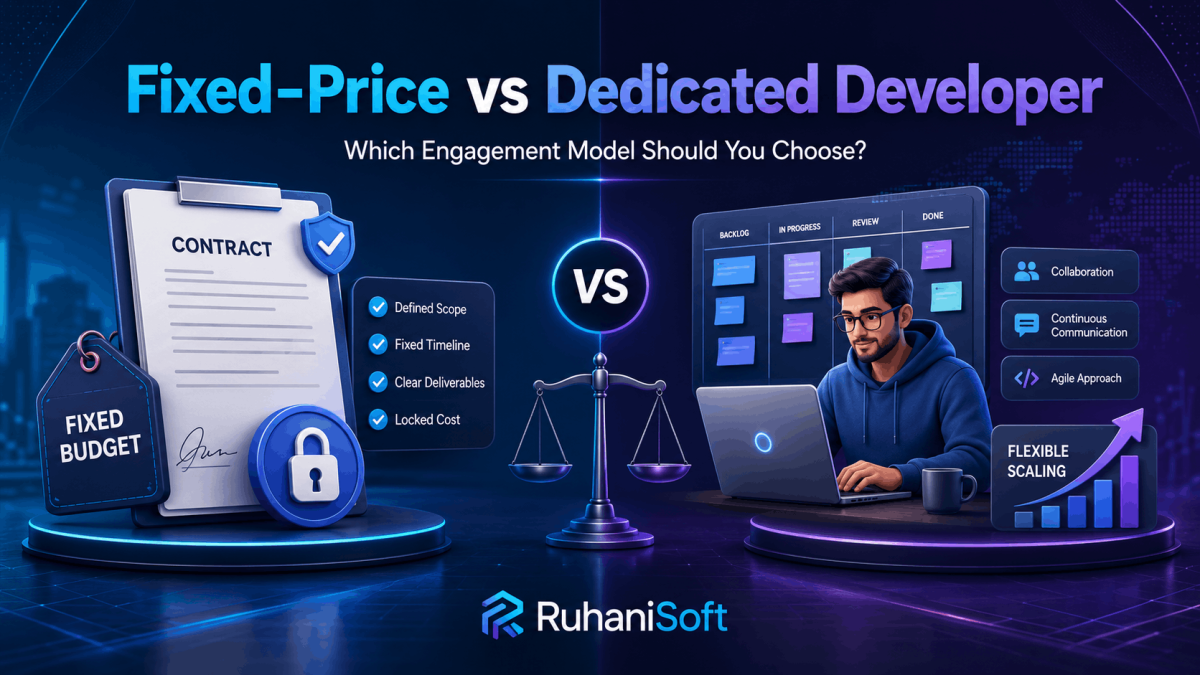
Choosing the right software development partner is important, but selecting the right engagement model is equally critical. The model you choose determines how your project is priced, managed, delivered, and adjusted when requirements change.
Two of the most common options are the fixed-price model and the dedicated developer model. A fixed-price agreement offers a predetermined budget and clearly defined scope. A dedicated developer arrangement gives you ongoing access to one or more developers who work as an extension of your internal team.
Neither model is automatically better for every project. The right choice depends on your project scope, budget, timeline, technical complexity, and desired level of control.
In this guide, we compare fixed-price and dedicated developer engagement models to help startups, agencies, and established businesses make a confident decision.
What Is a Software Development Engagement Model?
A software development engagement model defines the commercial and operational relationship between a business and its development partner. It explains how the team will be structured, how costs will be calculated, how responsibilities will be divided, and how the project will be managed.
Your engagement model can affect:
- Project cost and payment structure
- Development timeline
- Ability to change requirements
- Level of client involvement
- Team availability
- Communication process
- Project ownership and accountability
- Long-term scalability
Selecting an unsuitable model can lead to scope disputes, budget overruns, delays, or reduced product quality. A suitable model creates clear expectations for both the client and the software development company.
What Is the Fixed-Price Development Model?
Under a fixed-price model, the software development company agrees to complete a defined project for a predetermined price. The project scope, features, deliverables, timeline, and acceptance criteria are usually documented before development begins.
For example, a company might hire a development agency to build a Laravel-based appointment booking platform for a fixed price. The agreement could include user registration, booking management, online payments, an administrative dashboard, and a specific delivery schedule.
If the requirements remain unchanged, the client pays the agreed amount regardless of the number of development hours required.
How the Fixed-Price Model Works
A typical fixed-price project follows these stages:
- The client provides detailed project requirements.
- The development company analyzes the scope and technical complexity.
- Features, deliverables, milestones, and acceptance conditions are documented.
- The development company estimates the total cost and timeline.
- Both parties approve the agreement.
- The team develops and delivers the project according to the approved scope.
- Any additional requirements are handled through a separate change request.
The accuracy of the original requirements has a major impact on the success of a fixed-price project.
Advantages of the Fixed-Price Model
1. Predictable Project Cost
The client knows the agreed development cost before the project begins. This makes budgeting easier, especially for startups and small businesses working with limited financial resources.
2. Clear Scope and Deliverables
Features, milestones, and acceptance criteria are defined in advance. This gives both parties a shared understanding of what must be delivered.
3. Lower Management Involvement
The development company is generally responsible for organizing the team and managing implementation. The client still provides feedback, but does not need to supervise daily development activities.
4. Suitable for Short and Clearly Defined Projects
The fixed-price model works well for landing pages, company websites, minimum viable products with stable requirements, integrations, and small business applications.
5. Milestone-Based Payments
Fixed-price projects can be divided into milestones. The client can review progress and approve deliverables before releasing each payment.
Limitations of the Fixed-Price Model
1. Limited Flexibility
Once the scope has been approved, adding or changing features may require a formal change request. Every change can affect the budget and delivery timeline.
2. More Planning Before Development
The development partner needs detailed requirements to estimate the project accurately. Discovery, documentation, and technical planning may take considerable time before coding begins.
3. Risk of Scope Misunderstanding
If a requirement is unclear, the client and development team may interpret it differently. Detailed documentation and acceptance criteria are essential for preventing disputes.
4. Less Suitable for Experimental Products
Startups often change features after receiving feedback from early users. A rigid fixed scope may make continuous experimentation difficult and expensive.
5. Change Requests Can Increase Costs
The initial price is predictable only when the scope remains stable. Frequent changes can increase the total cost beyond the original estimate.
What Is the Dedicated Developer Model?
Under the dedicated developer model, a business hires one or more developers who work specifically on its projects for an agreed period. The developers become an extension of the client’s existing team while remaining employed or managed by the outsourcing company.
The client typically pays a monthly rate based on the number of developers, their experience, and the required technical skills.
For example, a startup may hire a dedicated Laravel developer, frontend developer, and quality assurance engineer for six months. The startup can assign tasks, adjust priorities, and refine features throughout the engagement.
How the Dedicated Developer Model Works
A dedicated developer engagement generally follows these steps:
- The client defines the required skills and experience.
- The development partner recommends suitable developers.
- The client reviews profiles and participates in interviews.
- The selected developers join the client’s workflow.
- The client assigns tasks and sets priorities.
- The developers work according to agreed hours and reporting processes.
- The team can be expanded or reduced as project needs change.
This model prioritizes ongoing collaboration, flexibility, and direct control over development priorities.
Advantages of Hiring Dedicated Developers
1. Greater Flexibility
You can modify features, change priorities, and respond to customer feedback without renegotiating the entire project scope.
2. Direct Control Over Development
The client can communicate directly with the developers, assign tasks, participate in sprint planning, and review progress regularly.
3. Better for Long-Term Projects
Dedicated developers are suitable for products that require continuous development, maintenance, optimization, and new feature releases.
4. Strong Product Knowledge
Developers working on the same product over time gain a deeper understanding of its codebase, users, architecture, and business objectives. This knowledge can improve development speed and decision-making.
5. Easy Team Scaling
You can add developers, designers, quality assurance engineers, or DevOps specialists as the project grows. You can also reduce the team when the workload decreases, depending on the agreement.
6. Transparent Workload
Clients can track tasks, completed work, development hours, and sprint progress using tools such as Jira, Trello, GitHub, or ClickUp.
Limitations of the Dedicated Developer Model
1. The Final Cost Is Not Always Known in Advance
Because the engagement is usually billed monthly, the total cost depends on how long development continues and how many team members are involved.
2. Greater Client Involvement
The client may need to participate in planning, task prioritization, feedback sessions, and product decisions. This can be difficult for businesses without an internal technical manager.
3. Requires Consistent Communication
Dedicated development works best when the client and developers communicate regularly. Delayed decisions and unclear priorities can reduce productivity.
4. Not Always Cost-Effective for Very Small Tasks
Hiring a dedicated developer for a minor bug fix or a small, one-time feature may not be practical. A fixed-price arrangement may be more suitable for such work.
Fixed-Price vs Dedicated Developer: Key Differences
| Comparison Area | Fixed-Price Model | Dedicated Developer Model |
|---|---|---|
| Pricing | Predetermined project price | Usually billed monthly |
| Project Scope | Defined before development | Can evolve during development |
| Flexibility | Limited | High |
| Client Involvement | Low to moderate | Moderate to high |
| Budget Predictability | High for an unchanged scope | Depends on team size and duration |
| Best Project Type | Small or well-defined projects | Complex and long-term products |
| Requirement Changes | Handled through change requests | Can be added to future sprints |
| Team Scaling | Usually limited by contract scope | Relatively easy |
| Product Knowledge | Usually limited to project duration | Builds continuously over time |
| Time to Start | May require extensive planning | Can begin after developer selection |
When Should You Choose the Fixed-Price Model?
A fixed-price arrangement may be the right choice when:
- Your project requirements are complete and unlikely to change.
- You have a specific budget that cannot be exceeded.
- The project has a clear beginning and end.
- You need a small website, application, integration, or feature.
- You have documented workflows and acceptance criteria.
- You cannot manage developers on a daily basis.
- You want payment linked to predefined milestones.
Examples of suitable fixed-price projects include:
- A corporate website with approved designs
- A Laravel-based internal tool with a defined workflow
- A payment gateway integration
- A website migration
- A predefined application module
- A small MVP with validated requirements
- Performance optimization with measurable targets
When Should You Hire a Dedicated Developer?
A dedicated developer or development team may be more suitable when:
- Your requirements are expected to evolve.
- You are building a long-term software product.
- You need ongoing Laravel or PHP development.
- You want direct control over tasks and priorities.
- You already have a product manager or technical lead.
- You need to expand your internal team quickly.
- You want developers to become familiar with your business.
- You plan to release features continuously.
Common dedicated development use cases include:
- Software as a Service platforms
- Large Laravel applications
- Marketplace platforms
- Customer portals
- Legacy application modernization
- Ongoing API development
- Application maintenance and support
- Agency development capacity extension
Which Model Is Better for Startups?
The right model for a startup depends on the stage of the product.
A fixed-price model can work for a startup that has validated its idea, finalized the feature set, prepared designs, and needs a clearly scoped MVP. It gives founders a predictable initial development cost.
However, many early-stage startups are still testing their assumptions. User feedback may require changes to onboarding, pricing, workflows, or core features. In this situation, a dedicated developer model usually provides greater flexibility.
A practical approach is to begin with a short discovery phase. The development partner can define the product requirements, technical architecture, priorities, and MVP scope. The startup can then select a fixed-price model for a stable scope or a dedicated model for continuous experimentation.
Which Model Is Better for Digital Agencies?
Digital agencies often need additional development capacity without permanently hiring more employees. Dedicated developers can work as an extension of the agency’s internal team and help deliver multiple client projects.
This arrangement is useful when an agency needs:
- Reliable Laravel or PHP expertise
- Additional capacity during busy periods
- White-label development support
- Long-term technical collaboration
- Faster project delivery
Fixed-price outsourcing can still be useful when the agency wants to subcontract one clearly defined project. For ongoing capacity across several projects, a dedicated developer is generally more practical.
How Requirement Changes Affect Each Model
Requirement changes are one of the biggest differences between these engagement models.
In a fixed-price project, each significant change must be evaluated. The development company may need to provide a new cost and timeline estimate. Development can be delayed if changes are introduced frequently.
With a dedicated developer, new requirements can be prioritized within future development cycles. The client may replace a lower-priority task with a more urgent one without changing the commercial structure.
If you expect frequent experimentation, integrations, or customer-driven improvements, the dedicated model is usually easier to manage.
How to Compare the Real Cost
Businesses sometimes compare only the initial quotations. This does not always reveal the true long-term cost.
When comparing engagement models, consider:
- Discovery and documentation expenses
- Development and quality assurance
- Project management
- Infrastructure and deployment
- Change requests
- Bug fixes and warranty terms
- Ongoing maintenance
- Future feature development
- Knowledge transfer
- Team replacement or scaling costs
A low fixed quotation may become more expensive if the project requires many changes. A dedicated developer may cost more per month but create greater long-term value through flexibility, product knowledge, and continuous delivery.
Can You Combine Both Engagement Models?
Yes. Some projects benefit from a hybrid approach.
For example, a company can use a fixed-price model for the discovery and initial MVP development. After the MVP launches, it can hire a dedicated developer for maintenance, user feedback implementation, and new feature development.
Another option is to hire a dedicated team for the main product while using fixed-price agreements for isolated tasks such as security audits, third-party integrations, or data migrations.
A hybrid model can provide budget control during predictable phases and flexibility during periods of continuous growth.
Questions to Ask Before Choosing an Engagement Model
Before signing an agreement, discuss the following questions with your development partner:
- Are the project requirements complete and documented?
- How likely are the requirements to change?
- Is the budget fixed or flexible?
- Does the project have a strict deadline?
- Who will prioritize tasks and approve deliverables?
- How frequently do you want progress updates?
- Do you have internal technical leadership?
- Will the product require continuous maintenance?
- How quickly might the development team need to scale?
- What happens when a developer becomes unavailable?
- Who owns the source code and intellectual property?
- How will security and confidentiality be managed?
Clear answers will make it easier to identify the model that aligns with your business and operational needs.
Common Mistakes to Avoid
Choosing Fixed Price Without Clear Requirements
A fixed budget cannot compensate for an unclear scope. Incomplete requirements often lead to misunderstandings, change requests, and delays.
Hiring Dedicated Developers Without a Work Pipeline
A dedicated developer needs consistent tasks, priorities, and feedback. Hiring a full-time resource without enough planned work can reduce cost efficiency.
Selecting Based Only on the Lowest Rate
Development quality, communication, reliability, security, and technical experience are more important than the lowest quotation or hourly rate.
Ignoring Post-Launch Requirements
Software products require maintenance, security updates, monitoring, and improvements after release. Your engagement decision should account for the complete product lifecycle.
Failing to Define Communication Expectations
Agree on communication channels, meeting frequency, reporting format, working hours, and response times before development begins.
How RuhaniSoft Supports Both Engagement Models
RuhaniSoft provides flexible offshore Laravel and PHP development services for startups, software companies, and digital agencies. Clients can select a fixed-price project or hire dedicated developers based on their scope, budget, and long-term goals.
For well-defined projects, RuhaniSoft can evaluate the requirements, prepare a clear implementation plan, define milestones, and provide a fixed-price proposal.
For evolving or long-term products, businesses can hire dedicated Laravel and PHP developers who integrate with their existing workflow. This gives clients greater control over priorities while providing access to specialized offshore development expertise.
RuhaniSoft can support projects involving:
- Custom Laravel application development
- PHP software development
- SaaS platform development
- API development and integration
- Legacy PHP modernization
- Application maintenance and optimization
- Dedicated development teams
- White-label development for agencies
How to Make the Right Decision
Choose the fixed-price model when your project has clear requirements, a limited scope, a defined deadline, and a strict budget. It offers predictability and requires less daily management from the client.
Choose the dedicated developer model when your product is complex, long-term, or likely to evolve. It provides flexibility, direct control, scalable resources, and stronger knowledge retention.
If you are still uncertain, begin with a discovery phase. A detailed technical and business analysis can reveal whether your requirements are stable enough for fixed pricing or flexible enough to require dedicated development.
The best engagement model is not simply the one with the lowest initial cost. It is the model that supports your product goals, reduces delivery risks, and allows your business to build reliable software efficiently.
Frequently Asked Questions
Is a fixed-price project always cheaper?
No. A fixed-price project offers cost predictability for an unchanged scope. If requirements change frequently, additional change requests can increase the final cost.
Can I hire a dedicated developer for a short period?
Yes. Many development companies offer dedicated developers for a minimum monthly period. The exact commitment depends on the provider and resource availability.
Who manages a dedicated developer?
The client usually controls priorities and provides product direction. The outsourcing partner may handle employment, availability, administrative support, and technical supervision.
Which model is better for an MVP?
A fixed-price model can be effective when the MVP requirements are validated and clearly documented. A dedicated developer is better when the startup expects to test ideas and adjust features during development.
Can I switch from fixed price to a dedicated team?
Yes. A common approach is to complete the initial version under a fixed-price agreement and then hire dedicated developers for ongoing maintenance and product expansion.
How do I protect my source code and business information?
Use a written agreement covering source code ownership, intellectual property rights, confidentiality, access control, data protection, and repository management.
Why hire an offshore dedicated developer?
An offshore dedicated developer can provide access to specialized skills, flexible team scaling, and competitive development costs. Success depends on selecting a reliable partner with strong communication and project management processes.