
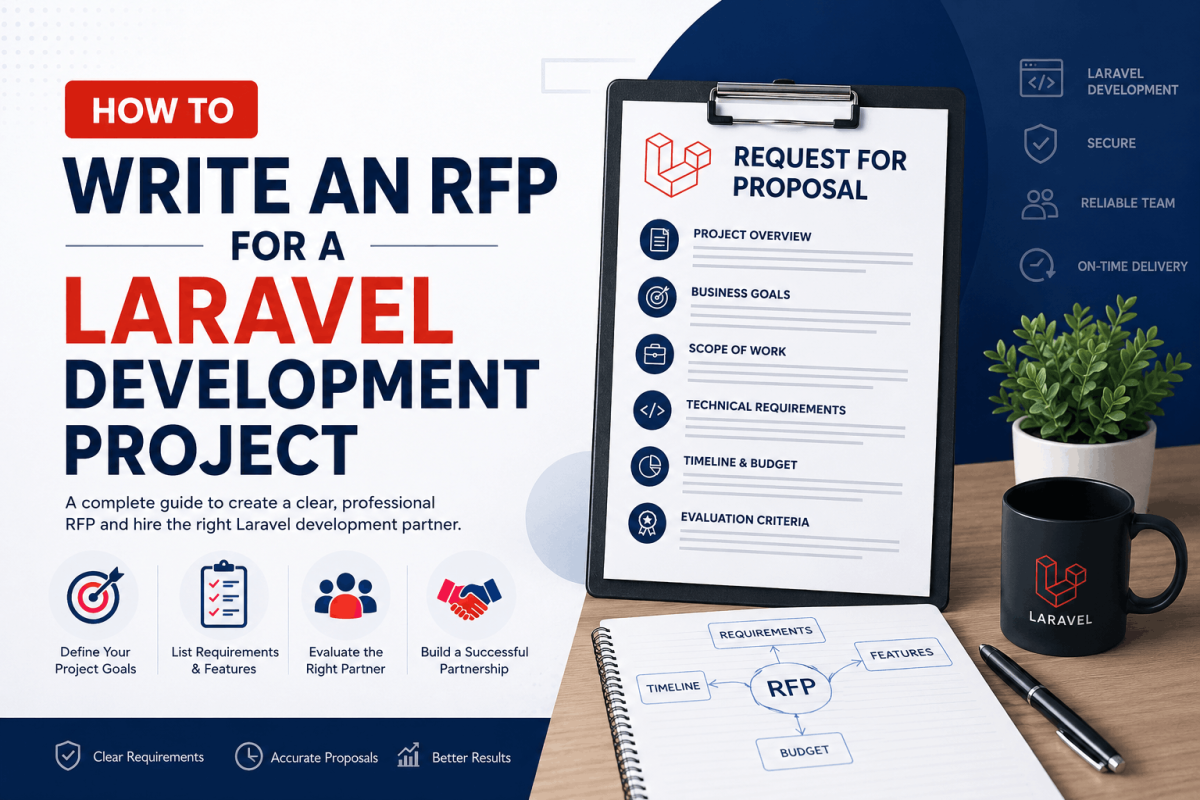
Writing a strong request for proposal, commonly known as an RFP, is one of the most important steps in hiring the right Laravel development partner.
A well-prepared RFP helps development companies understand your goals, technical requirements, budget expectations, timeline, and decision-making process. It also helps you receive more accurate proposals, compare vendors fairly, and avoid misunderstandings after development begins.
Many Laravel projects face delays, cost increases, and quality issues because the initial requirements are too vague. A company may send a short message such as “We need a Laravel website” and expect agencies to provide an accurate estimate. In practice, this leaves too many unanswered questions.
At RuhaniSoft, we regularly review Laravel project requirements from startups, agencies, and growing businesses. The clearest projects usually begin with a structured RFP that explains the business problem before discussing features.
This guide explains how to write an effective RFP for a Laravel development project and how RuhaniSoft can help turn that document into a practical development plan.
What Is an RFP for a Laravel Development Project?
An RFP is a formal document that explains what you want to build and invites Laravel development companies to submit a proposal.
The document usually includes:
- Information about your company
- The business problem you want to solve
- The project goals
- The required Laravel features
- The expected user roles
- Technical requirements
- Design requirements
- Integration requirements
- Timeline expectations
- Budget guidance
- Vendor selection criteria
- Proposal submission instructions
An RFP does not need to contain every technical detail. It should provide enough information for a Laravel development company to understand the project, identify risks, ask useful questions, and prepare a realistic estimate.
Why a Good Laravel RFP Matters
A detailed RFP creates a better foundation for the entire project.
It helps you:
- Receive more accurate cost estimates
- Reduce unnecessary back-and-forth communication
- Compare Laravel vendors using the same criteria
- Identify missing requirements early
- Clarify project ownership and responsibilities
- Reduce the risk of scope disputes
- Plan development milestones more effectively
- Improve delivery timelines
- Understand what is included and excluded
For RuhaniSoft, a clear RFP also makes it easier to recommend the right engagement model, team size, Laravel architecture, delivery process, and maintenance plan.
When the requirements are unclear, any early quote is likely to be based on assumptions. A strong RFP reduces those assumptions.
Start With a Clear Project Summary
The first section of your RFP should summarize the project in simple business language.
Explain what you are building, who will use it, and why the project matters.
For example:
We want to build a Laravel-based client management platform for a consulting company. The platform will allow staff to manage clients, projects, invoices, documents, tasks, and customer support requests. Clients will have a separate portal where they can view progress, upload files, approve quotations, and pay invoices.
This summary gives RuhaniSoft or another Laravel development company immediate context.
Avoid beginning with a large feature list without explaining the business purpose. Developers need to understand the reason behind the system, not only the screens you want.
Introduce Your Company
Include a short description of your business.
You can mention:
- Your industry
- Your target customers
- Your company size
- Your current technology setup
- Your operating regions
- Whether the project is internal or customer-facing
- Whether you have an existing technical team
This information helps RuhaniSoft understand the level of complexity, compliance needs, user expectations, and communication style required.
For example, a startup building an MVP has different priorities from an established company replacing a legacy internal platform.
Define the Business Problem
One of the most useful sections in an RFP is the problem statement.
Explain what is currently difficult, inefficient, expensive, or impossible.
Examples include:
- Employees are managing customer data in spreadsheets
- Customers cannot track project progress online
- Existing software does not support local payment methods
- The current PHP application is outdated and difficult to maintain
- Manual reporting takes several hours every week
- Different departments use disconnected tools
- The business needs a scalable SaaS platform
This section helps RuhaniSoft propose a solution that addresses the actual business issue instead of simply reproducing an inefficient process in Laravel.
List the Main Project Goals
Your RFP should contain measurable project goals.
Examples may include:
- Reduce manual data entry
- Launch an MVP within four months
- Support 10,000 registered users
- Allow customers to complete payments online
- Replace an outdated legacy PHP system
- Improve reporting accuracy
- Provide a self-service client portal
- Support multiple countries and currencies
- Automate internal approval workflows
RuhaniSoft can use these goals to prioritize features and recommend which modules should be included in the first release.
Describe the Target Users
Every Laravel platform has one or more user types. Your RFP should identify them clearly.
Common user roles include:
- Super administrator
- Company administrator
- Manager
- Employee
- Client
- Vendor
- Agent
- Customer
- Subscriber
- Support representative
For each user role, explain what the user should be able to do.
For example:
Administrator
- Manage users
- Configure system settings
- View reports
- Manage subscriptions
- Review activity logs
Client
- Log in securely
- View assigned projects
- Upload documents
- Approve quotations
- View invoices
- Submit support tickets
This structure helps RuhaniSoft estimate permissions, dashboards, workflows, notifications, and development effort more accurately.
Separate Must-Have and Optional Features
Not every feature has the same priority.
Divide features into categories such as:
- Required for launch
- Important but not essential
- Planned for a later phase
- Optional depending on budget
This is especially important for startups and MVP projects.
RuhaniSoft often helps clients reduce the first release to the features required to validate the product and begin operating. Additional features can then be added based on real customer feedback.
A prioritized feature list also makes it easier to prepare separate estimates for Phase One and future development.
Describe the Core Laravel Modules
Your RFP should describe the main modules you expect the application to include.
Depending on the project, these may include:
- User authentication
- User management
- Role and permission management
- Dashboard
- Customer management
- Project management
- Task management
- Document management
- Subscription billing
- Invoice management
- Payment processing
- Reporting
- Email notifications
- Audit logs
- Support tickets
- Settings
For each module, provide a brief description of what it should do.
Avoid using only module names. “Project management” can mean different things to different companies.
Explain whether it includes tasks, milestones, team members, deadlines, file attachments, comments, approval workflows, and time tracking.
Include User Workflows
A workflow explains the sequence of actions a user completes.
For example:
- A customer creates an account
- The customer submits an application
- An administrator reviews the application
- The administrator requests additional documents
- The customer uploads the documents
- The administrator approves the application
- The system sends an email confirmation
Workflows are extremely valuable because they show how different Laravel modules connect.
RuhaniSoft uses these workflows to identify:
- Required database relationships
- Permission rules
- Status changes
- Notification triggers
- Approval logic
- Validation requirements
- Potential edge cases
You can describe workflows using numbered steps, diagrams, screenshots, or short user stories.
Add User Stories Where Possible
User stories are simple statements that explain what a user wants to do and why.
A common format is:
As a client, I want to upload project documents so that the agency can review them without email attachments.
Other examples include:
- As an administrator, I want to assign projects to employees
- As a customer, I want to reset my password securely
- As a manager, I want to export monthly reports
- As a subscriber, I want to upgrade my plan
- As a support agent, I want to respond to assigned tickets
User stories help RuhaniSoft understand the expected result from the user's perspective.
Explain Your Design Requirements
State whether you need UI and UX design as part of the project.
Include information such as:
- Whether you already have a design
- Whether you have Figma files
- Whether you have a brand guide
- Whether the platform must be responsive
- Whether accessibility is required
- Whether a mobile-first layout is needed
- Whether you need both public pages and dashboards
- Whether multiple themes are required
You can also include examples of websites or applications you like.
Explain what you like about them, such as navigation, layout, spacing, dashboard structure, or user experience.
RuhaniSoft can work from existing designs or support the complete process from interface planning to Laravel implementation.
List Required Third-Party Integrations
Laravel applications frequently connect with external services.
Your RFP should identify known integrations, such as:
- Stripe
- PayPal
- Flutterwave
- Paystack
- Razorpay
- Twilio
- Mailgun
- Amazon S3
- Google Maps
- Google Calendar
- Accounting platforms
- CRM systems
- Shipping providers
- Government or industry APIs
For each integration, mention what it will be used for.
For example, do not only write “Stripe integration.” Explain whether you need one-time payments, subscriptions, coupons, refunds, invoicing, tax calculation, or marketplace payments.
RuhaniSoft can then evaluate API limitations, security requirements, webhook handling, testing environments, and regional availability.
Mention Existing Systems and Data Migration
If you already have a system, explain what will happen to it.
Your project may require:
- Migrating from another PHP framework
- Upgrading an older Laravel version
- Importing spreadsheet data
- Moving customer records from a CRM
- Rebuilding an existing application
- Connecting the new Laravel application to a legacy database
- Preserving existing URLs
- Migrating files and documents
Provide information about:
- Current framework
- Laravel or PHP version
- Database type
- Approximate number of records
- Known technical issues
- Existing source code availability
- Current hosting environment
RuhaniSoft can review the existing architecture and recommend whether the project should be upgraded, refactored, integrated, or rebuilt.
Specify Technical Requirements
You do not need to design the full technical architecture, but you should mention any fixed technical requirements.
Examples include:
- The application must use Laravel
- The API must follow REST principles
- The platform must support MySQL or PostgreSQL
- The frontend must use Vue, React, Blade, or Livewire
- The application must support multiple languages
- The application must use a cloud hosting provider
- The project must include automated tests
- The source code must be stored in GitHub or GitLab
- The platform must support Docker
- The application must include API documentation
If you are unsure about the best architecture, state that you expect the Laravel agency to recommend one.
RuhaniSoft can evaluate your requirements and propose a practical stack based on expected users, budget, complexity, and future growth.
Include Performance Expectations
Your RFP should mention expected usage.
Include estimates such as:
- Expected number of users
- Expected number of daily logins
- Expected number of transactions
- Expected file storage volume
- Expected traffic growth
- Expected report size
- Expected API request volume
Even rough estimates are useful.
A Laravel application designed for 100 internal users has different infrastructure requirements from a SaaS platform designed for 100,000 customers.
RuhaniSoft can use this information to plan caching, queues, database indexes, file storage, background jobs, and server architecture.
Describe Security and Compliance Requirements
Security requirements should be included from the beginning.
Depending on your industry, you may need:
- Two-factor authentication
- Role-based access control
- Audit logs
- Data encryption
- Secure file storage
- Session management
- IP restrictions
- Password policies
- GDPR support
- Data retention rules
- Consent tracking
- Regular security updates
Do not assume that every vendor follows the same security process.
Ask Laravel companies to explain how they manage:
- Environment credentials
- Production access
- Source code access
- Security testing
- Dependency updates
- Backups
- Logging
- Incident response
RuhaniSoft can include security requirements in the project architecture, development standards, access controls, and deployment process.
Explain Hosting and Deployment Expectations
State whether you already have hosting or need a recommendation.
Common options include:
- Shared hosting
- Virtual private server
- DigitalOcean
- AWS
- Google Cloud
- Microsoft Azure
- Laravel Forge
- Managed Laravel hosting
Also mention whether you need:
- Staging and production environments
- Automated deployment
- Server monitoring
- Backups
- SSL configuration
- Queue workers
- Scheduled tasks
- Load balancing
- CDN configuration
RuhaniSoft can support Laravel deployment, server configuration, CI/CD setup, and production handover based on the project scope.
Define Testing and Quality Expectations
Ask vendors to explain how they test Laravel applications.
Your RFP can request:
- Manual functional testing
- Unit testing
- Feature testing
- Browser testing
- API testing
- Responsive testing
- Regression testing
- User acceptance testing support
- Security testing
- Performance testing
At RuhaniSoft, testing expectations can be defined before development begins so that quality assurance is included in sprint planning rather than treated as a final activity.
Set a Realistic Project Timeline
Your RFP should include your preferred timeline, but avoid setting a deadline without considering project complexity.
Include:
- Preferred development start date
- Target launch date
- Important business deadlines
- Expected proposal submission date
- Vendor selection date
- Internal review periods
Also explain whether the date is fixed or flexible.
RuhaniSoft can divide the project into discovery, design, development, testing, deployment, and support phases. This creates a more realistic delivery plan than using one final deadline for the entire project.
Provide a Budget Range
Many companies avoid mentioning budget because they fear receiving higher quotes.
In practice, a realistic budget range helps Laravel agencies propose an appropriate solution.
Without a budget, a vendor may propose a large custom platform when you only need an MVP, or a simple solution when you require an enterprise-ready system.
Your budget section can include:
- Estimated total budget
- Preferred payment structure
- Whether the budget is fixed
- Whether the project may be delivered in phases
- Whether maintenance has a separate budget
RuhaniSoft can recommend a fixed-price, milestone-based, dedicated developer, or dedicated team model depending on the clarity and flexibility of the scope.
Choose the Right Engagement Model
Your RFP can ask vendors to recommend the best engagement model.
Common models include:
Fixed-Price Project
Suitable when the requirements, features, and acceptance criteria are clearly defined.
Dedicated Laravel Developer
Suitable when you need ongoing Laravel development capacity and want to manage priorities over time.
Dedicated Laravel Team
Suitable for larger or faster-moving projects that need backend, frontend, QA, and project management support.
Time and Materials
Suitable when requirements are expected to evolve during development.
RuhaniSoft supports flexible engagement models for startups, agencies, and businesses that need offshore Laravel development without building a full in-house department.
Explain Your Communication Expectations
Your RFP should describe how you want the project to be managed.
Include preferences for:
- Weekly meetings
- Daily updates
- Sprint reports
- Project management tools
- Communication platforms
- Time zone overlap
- Decision-making responsibilities
- Access to developers
RuhaniSoft commonly organizes Laravel projects through weekly sprints, shared task tracking, source control, structured updates, and milestone reviews.
This gives clients visibility without requiring them to manage every development task.
Request a Clear Deliverables List
Ask vendors to list everything that will be delivered.
Deliverables may include:
- Laravel source code
- Frontend source code
- Database migrations
- API documentation
- Deployment documentation
- Admin panel
- User portal
- Automated tests
- Design files
- Training materials
- Technical documentation
- Production deployment
This reduces confusion at the end of the project.
RuhaniSoft can include clear deliverables for every project milestone so clients understand what will be reviewed and approved.
Define Source Code and Intellectual Property Ownership
Your RFP should state that the client expects ownership of the completed project after payment.
Clarify ownership of:
- Source code
- Database design
- Custom UI designs
- Documentation
- Domain and hosting accounts
- Third-party service accounts
- Repository access
Also ask vendors to identify any commercial libraries, licensed templates, or third-party components that will be used.
RuhaniSoft can provide transparent source code handover and repository access based on the agreed project terms.
Ask About Post-Launch Support
A Laravel project does not end when it is deployed.
Your RFP should ask about:
- Bug-fix warranty
- Maintenance packages
- Laravel upgrades
- PHP upgrades
- Server monitoring
- Performance optimization
- Emergency support
- Feature development
- Security updates
RuhaniSoft supports clients with ongoing Laravel maintenance, feature development, bug fixing, performance improvements, and project handover support.
Define Vendor Selection Criteria
Explain how you will evaluate proposals.
Possible selection criteria include:
- Laravel experience
- Relevant portfolio
- Technical approach
- Communication process
- Project management method
- Testing process
- Proposed timeline
- Cost
- Post-launch support
- Team availability
- Understanding of the business problem
Do not select a Laravel company based only on the lowest price.
A stronger proposal may cost more but include better planning, testing, documentation, communication, and long-term support.
Questions to Ask Laravel Development Companies
Your RFP can ask vendors to answer the following questions:
- How many Laravel projects have you completed?
- Have you built a similar platform?
- Which Laravel version do you recommend?
- Who will work on the project?
- Will the developers be dedicated?
- How will the project be managed?
- How frequently will updates be provided?
- How do you test Laravel applications?
- How do you handle scope changes?
- How do you protect source code and credentials?
- What support is available after launch?
- What happens if a team member becomes unavailable?
- Will we receive full repository access?
- What documentation will be delivered?
RuhaniSoft can answer these questions during the proposal and discovery process so clients understand how the project will be delivered before development starts.
Common Mistakes to Avoid in a Laravel RFP
Writing Only a Feature List
A feature list without business context makes it difficult to recommend the right solution.
Leaving Out User Roles
Permissions and dashboards can significantly affect development complexity.
Not Prioritizing Features
When every feature is treated as essential, the project may become unnecessarily large and expensive.
Ignoring Third-Party Integration Details
Integration complexity depends on the exact workflow, API limitations, and regional requirements.
Setting an Unrealistic Deadline
A deadline should consider planning, design, development, testing, feedback, and deployment.
Selecting Only by Price
A low quote may exclude testing, project management, documentation, deployment, or support.
Not Defining Acceptance Criteria
Without clear acceptance criteria, it becomes difficult to decide whether a feature is complete.
Not Planning for Maintenance
Laravel applications require updates, security patches, and ongoing support after launch.
Sample Laravel RFP Structure
You can use the following structure for your RFP:
- Company introduction
- Project summary
- Business problem
- Project goals
- Target users
- User roles
- Required features
- Optional features
- User workflows
- Design requirements
- Technical requirements
- Integration requirements
- Data migration requirements
- Security requirements
- Performance expectations
- Hosting and deployment
- Testing requirements
- Timeline
- Budget range
- Deliverables
- Support requirements
- Vendor questions
- Selection criteria
- Proposal submission instructions
Why Send Your Laravel RFP to RuhaniSoft?
RuhaniSoft works with startups, agencies, and growing businesses that need reliable offshore Laravel development support.
We can review your RFP and help you:
- Clarify unclear requirements
- Identify missing workflows
- Prioritize MVP features
- Choose the right Laravel architecture
- Estimate development effort
- Plan project milestones
- Select the right engagement model
- Prepare a practical delivery roadmap
- Reduce unnecessary development costs
RuhaniSoft provides services including:
- Custom Laravel application development
- Dedicated Laravel developers
- Offshore Laravel development teams
- Laravel SaaS development
- API development
- Third-party integrations
- Legacy Laravel modernization
- Laravel maintenance
- Performance optimization
- Project handover and technical support
Our goal is not only to provide a quote. We help clients turn broad business ideas into clearly defined Laravel projects with realistic priorities, milestones, and technical decisions.
How RuhaniSoft Reviews a Laravel RFP
When RuhaniSoft receives an RFP, the review process typically includes:
- Understanding the business goals
- Reviewing the required user roles
- Analyzing the main workflows
- Identifying technical dependencies
- Reviewing integrations
- Finding missing requirements
- Estimating project complexity
- Recommending a development approach
- Preparing milestones and deliverables
- Providing a proposal and next steps
If the scope is not complete, RuhaniSoft can begin with a discovery phase before full development.
This is useful for complex platforms, SaaS products, internal business systems, and projects that involve multiple stakeholders.
What to Include When Contacting RuhaniSoft
When sending your Laravel project RFP to RuhaniSoft, include as much of the following information as possible:
- Project summary
- Business goals
- Feature list
- User roles
- Workflows
- Design files or references
- Integration list
- Existing source code details
- Target timeline
- Budget range
- Preferred engagement model
- Post-launch support needs
Do not worry if every detail is not complete. RuhaniSoft can help refine the scope and identify the information needed before development begins.
Build a Better Laravel Project With a Better RFP
A strong RFP improves more than the vendor selection process. It improves the entire Laravel development project.
It creates clearer expectations, better estimates, more accurate timelines, stronger communication, and fewer scope disputes.
Start with the business problem, describe the users, define the important workflows, prioritize the features, and explain your technical and operational expectations.
Then choose a Laravel development partner that asks thoughtful questions and understands the business purpose behind the application.
RuhaniSoft helps businesses turn Laravel project requirements into structured development plans and maintainable applications. Whether you need a dedicated Laravel developer, an offshore team, or complete project delivery, a clear RFP is the best place to begin.