
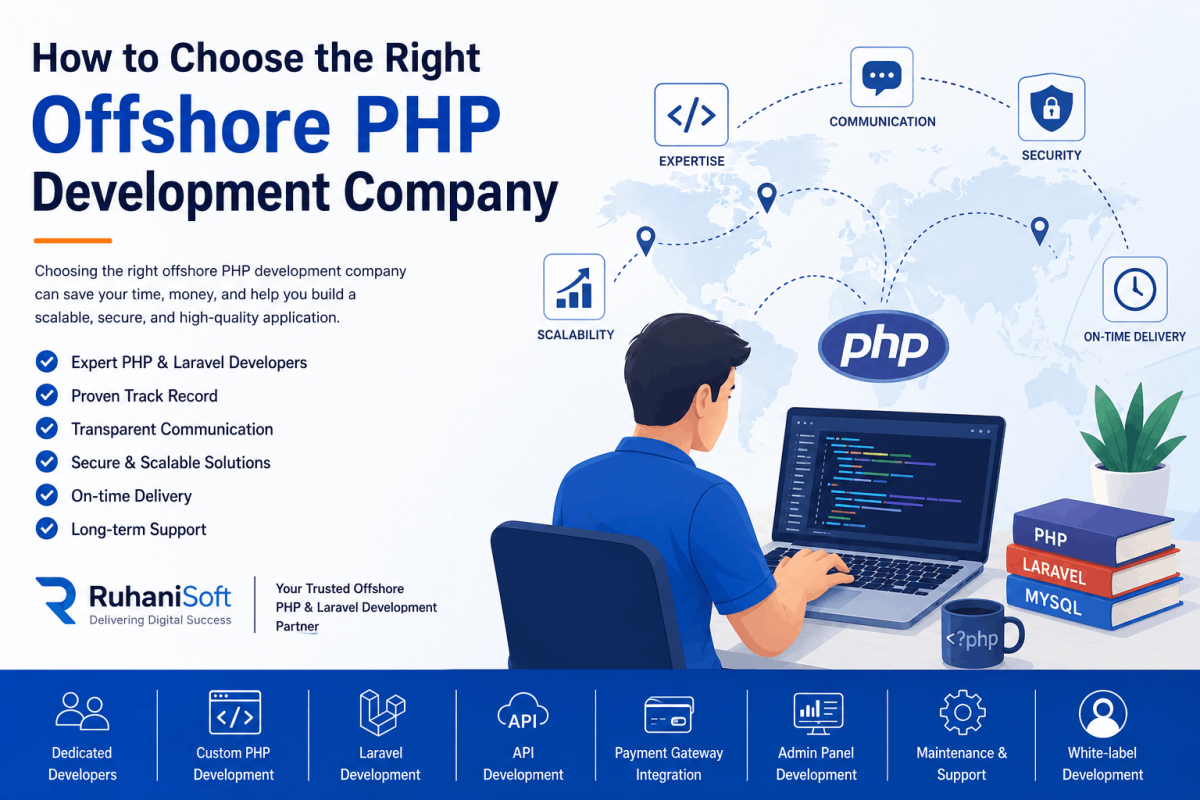
Choosing the right offshore PHP development company can determine whether your software project becomes a reliable business asset or an expensive technical problem.
Offshore development gives startups, digital agencies, SaaS companies, and growing businesses access to experienced developers without the cost and complexity of building a complete in-house engineering department. However, not every offshore company offers the same level of technical skill, communication, accountability, or long-term support.
A low quotation may look attractive initially, but poor architecture, undocumented code, missed deadlines, and weak security practices can make the project considerably more expensive over time.
The right partner should understand more than PHP syntax. It should understand your product goals, users, operational processes, scalability requirements, integrations, security risks, and future development plans.
This guide explains how to evaluate an offshore PHP development company and why businesses looking for dependable PHP and Laravel development should consider working with RuhaniSoft.
What Is an Offshore PHP Development Company?
An offshore PHP development company is a software development provider located in another country that builds, maintains, or modernizes PHP-based applications for international clients.
Depending on the provider, an offshore PHP team may help with:
- Custom PHP application development
- Laravel development
- CodeIgniter development
- Symfony application development
- SaaS product development
- REST API development
- Admin panel development
- Payment gateway integration
- Third-party software integration
- Legacy PHP modernization
- Application maintenance and support
- Dedicated developer hiring
- White-label development for digital agencies
Businesses usually choose offshore PHP development to increase delivery capacity, reduce operational costs, access specialized developers, or launch software faster.
However, successful outsourcing depends heavily on selecting a company that can operate as a responsible extension of your business rather than simply completing disconnected development tasks.
Why Choosing the Right PHP Partner Matters
A PHP application often becomes part of a company’s daily operations. It may manage customers, payments, subscriptions, employees, inventory, business reports, documents, or sensitive internal data.
When an unsuitable development company builds the system, the business may face:
- Unstable application performance
- Security vulnerabilities
- Poor database architecture
- Frequent production errors
- Missing documentation
- Unclear project ownership
- Difficulty adding new features
- Unexpected maintenance expenses
- Dependency on one developer
- Complete project rewrites
The right offshore PHP development company should reduce technical and operational risk. Its work should make the application easier to maintain, scale, test, and improve.
1. Define Your PHP Development Requirements
Before comparing companies, clearly define what you need to build or improve.
Your initial requirements do not need to be a complete technical specification. However, they should explain the business problem, intended users, major features, expected timeline, and available budget.
Questions to answer before contacting a company
- Are you building a new product or improving an existing application?
- Who will use the software?
- What business problem should it solve?
- Which features are essential for the first release?
- Does the system require payment processing?
- Will it connect with third-party APIs?
- Do you need a web application, API, admin panel, or complete SaaS platform?
- Do you already have designs or technical documentation?
- What is your preferred launch date?
- Will you require long-term maintenance?
Clear requirements allow an offshore company to recommend an appropriate architecture, engagement model, delivery plan, and budget.
At RuhaniSoft, project discussions begin with the business requirements rather than immediately assigning developers. This helps determine whether the project requires a complete development team, a dedicated Laravel developer, a fixed-scope implementation, or ongoing technical support.
2. Evaluate Relevant PHP and Framework Expertise
PHP development experience should be evaluated according to the type of application you need.
A company that has created basic WordPress websites may not be suitable for building a complex SaaS platform, subscription system, logistics application, marketplace, or enterprise administration portal.
Important PHP capabilities to evaluate
- Modern object-oriented PHP
- MVC architecture
- Laravel or another suitable PHP framework
- Composer dependency management
- MySQL and PostgreSQL
- Database optimization
- REST API architecture
- Authentication and authorization
- Queue and background job processing
- Caching and performance optimization
- Automated testing
- Git-based development workflows
- Cloud deployment
- Application monitoring
Ask the company to explain why it would select a particular framework, database, hosting environment, or application structure. A dependable company should be able to explain technical decisions in understandable business terms.
Why Laravel expertise is valuable
Laravel is widely used for custom business applications, SaaS products, APIs, internal platforms, marketplaces, and administration systems.
An experienced Laravel development team can use established framework features for routing, authentication, validation, background jobs, notifications, caching, database migrations, testing, and API development.
RuhaniSoft focuses heavily on Laravel and PHP development. The team works on SaaS platforms, business management applications, REST APIs, admin panels, payment systems, internal tools, and custom web software.
3. Review Experience With Similar Business Problems
Industry experience is useful, but direct experience with your exact industry should not be the only selection criterion.
What matters most is whether the company has solved similar technical and operational problems.
For example, a subscription platform may require:
- Recurring billing
- Role-based access
- Plan limitations
- Usage tracking
- Automated notifications
- Invoice management
- Account cancellation workflows
A logistics platform may require:
- Location tracking
- Driver or vehicle assignment
- Route management
- Status updates
- Proof of delivery
- Operational dashboards
Instead of asking only whether the company has built an application in your industry, ask whether it has implemented similar workflows, integrations, permission systems, reporting requirements, or scalability patterns.
4. Examine the Company’s Portfolio Carefully
A portfolio can provide evidence of technical range, design quality, and business understanding. However, screenshots alone do not reveal whether the company created the entire application.
When reviewing a project, ask:
- What part of the system did the company develop?
- Was it a new application or an existing codebase?
- Which technologies were used?
- What technical challenges were solved?
- Did the company handle deployment?
- Does the company still maintain the application?
Some projects cannot be shown publicly because of nondisclosure agreements. In that situation, the company should still be able to describe its technical approach without exposing confidential client information.
Look for evidence of real problem-solving rather than visually attractive interfaces alone.
5. Assess Code Quality and Architecture
Good code quality affects every future stage of your project. Clean and structured code is easier to test, review, maintain, and expand.
A professional PHP development company should follow practices such as:
- Clear separation of responsibilities
- Consistent coding standards
- Reusable service classes and components
- Database migrations and seeders
- Input validation
- Centralized error handling
- Environment-based configuration
- Git branch management
- Code reviews
- Automated tests for important workflows
- Technical documentation
Request a technical review when possible
For an existing application, request a codebase audit before committing to a large development contract.
The audit may identify:
- Outdated PHP or framework versions
- Security vulnerabilities
- Duplicated business logic
- Slow database queries
- Missing indexes
- Hardcoded credentials
- Unmaintained dependencies
- Incomplete deployment processes
- Insufficient test coverage
RuhaniSoft can review existing PHP and Laravel applications before recommending modernization, feature development, performance improvements, or a phased rebuild.
6. Check Security Practices
Security should be considered throughout the development process, not only before launch.
The development company should understand common risks involving authentication, authorization, user input, file uploads, APIs, database queries, sessions, credentials, third-party packages, and server configuration.
Security questions to ask
- How do you protect sensitive configuration values?
- How do you validate and sanitize user input?
- How do you manage user permissions?
- How do you secure file uploads?
- How are dependencies reviewed and updated?
- How do you protect API endpoints?
- How do you handle application logs?
- What happens when a security issue is discovered?
- Do you maintain backup and recovery procedures?
For applications involving payments, healthcare records, financial data, or confidential business information, security requirements should be documented before development begins.
RuhaniSoft designs PHP and Laravel applications with structured access control, validation, secure configuration, auditability, and maintainable application architecture in mind.
7. Evaluate Communication Skills
Communication problems are one of the most common causes of unsuccessful offshore development.
A technically strong team can still fail if it does not provide clear updates, report blockers, document decisions, or confirm requirements.
A reliable offshore company should provide
- A clear communication channel
- A responsible project contact
- Regular progress updates
- Written task descriptions
- Sprint or milestone reports
- Early reporting of risks and blockers
- Access to project management tools
- Demonstrations of completed work
During the first conversations, notice how the company responds to your questions. Does it ask useful questions about your business, or does it immediately provide a generic price?
A good partner should clarify assumptions before development begins.
Time zone differences should be managed
Offshore teams do not need to operate in the same time zone as the client. However, there should be a defined overlap period for meetings, reviews, and urgent discussions.
RuhaniSoft works with international clients through scheduled communication, documented tasks, milestone reviews, and regular project updates. This structure gives clients visibility without requiring constant meetings.
8. Understand the Project Management Process
Ask the company to explain how a requirement moves from discussion to production.
A structured workflow may include:
- Requirement discovery
- Scope definition
- Technical planning
- UI and workflow review
- Sprint planning
- Development
- Code review
- Testing
- Client demonstration
- Feedback implementation
- Deployment
- Post-launch monitoring
A company that cannot clearly describe its development workflow may also struggle to estimate timelines, manage changes, and maintain quality.
Look for transparency
You should know:
- What is currently being developed
- What has been completed
- Which tasks are blocked
- What will be delivered next
- Whether the project is within budget
- Whether the timeline has changed
RuhaniSoft uses milestone-based or sprint-based delivery depending on the project. Clients can review completed functionality regularly instead of waiting until the end of the entire development cycle.
9. Compare Engagement Models
Different projects require different commercial arrangements. Avoid selecting a company based only on the lowest hourly rate.
Fixed-price development
A fixed-price model is suitable when the requirements, features, timeline, and acceptance criteria are clearly defined.
It can work well for:
- Small applications
- Specific integrations
- Defined modules
- Website migrations
- Limited-scope upgrades
Dedicated PHP developer
A dedicated developer model is useful when you have ongoing tasks or need a developer to work closely with your existing team.
It is commonly used for:
- Continuous product development
- Maintenance and improvements
- Agency capacity extension
- Long-term SaaS development
- Projects with changing priorities
Dedicated development team
A dedicated team may include developers, a project coordinator, quality assurance support, and technical leadership.
This model is suitable for larger platforms that require continuous planning, implementation, testing, deployment, and support.
Time and materials
A time-and-materials agreement works well when the project cannot be fully estimated in advance. The client pays for the actual development effort used during each billing period.
RuhaniSoft can provide fixed-scope development, dedicated Laravel developers, offshore team support, or ongoing maintenance based on the project’s requirements.
10. Review Pricing Beyond the Hourly Rate
The cheapest hourly rate does not always produce the lowest total development cost.
An inexperienced developer may take considerably longer to complete a task, introduce defects, or create code that must later be rewritten.
When comparing quotations, evaluate:
- What services are included?
- Is project management included?
- Is testing included?
- Is deployment included?
- Are bug fixes covered?
- Is documentation included?
- Are meetings billable?
- How are scope changes priced?
- Is post-launch support included?
A clear quotation should explain the scope, assumptions, deliverables, timeline, payment schedule, and exclusions.
RuhaniSoft aims to provide transparent estimates based on the actual project scope. When requirements are uncertain, the project can be divided into discovery, development, and improvement phases.
11. Confirm Intellectual Property and Source Code Ownership
Your contract should clearly explain who owns the source code, designs, documentation, database structure, and project assets.
In most custom development arrangements, the client should receive ownership of the work after agreed payments have been completed.
Confirm access to essential assets
- Source code repository
- Hosting account
- Domain account
- Cloud infrastructure
- Database backups
- Third-party service accounts
- API credentials
- Deployment documentation
Avoid allowing critical infrastructure to remain permanently under a developer’s personal account.
RuhaniSoft can work with client-controlled repositories and infrastructure, making project access and ownership clearer throughout the engagement.
12. Ask About Testing and Quality Assurance
Testing should not be limited to checking whether a page opens successfully.
A PHP application may require several forms of testing:
- Feature testing
- API testing
- Permission testing
- Payment workflow testing
- Form validation testing
- Browser compatibility testing
- Responsive interface testing
- Database migration testing
- Performance testing
- Regression testing
Ask how the company records defects, verifies fixes, and prevents completed functionality from breaking during future releases.
For critical workflows, automated tests can reduce risk and improve long-term maintainability.
13. Evaluate Deployment and DevOps Capabilities
Development is only one part of delivering a reliable application. The team should also understand how to move the software safely from development to production.
Important deployment capabilities include
- Environment configuration
- Server setup
- Database migration management
- Git-based deployment
- Continuous integration
- Automated deployment pipelines
- Queue worker configuration
- Scheduled task configuration
- SSL configuration
- Backup management
- Error monitoring
- Rollback planning
A deployment process should minimize downtime and reduce the possibility of production errors.
RuhaniSoft supports PHP and Laravel deployment across common cloud, virtual server, and managed hosting environments. Deployment requirements can be included as part of the project rather than treated as an afterthought.
14. Check Long-Term Maintenance Options
Software is rarely complete after its first release. Business requirements change, dependencies receive updates, users report issues, and new integrations become necessary.
Before hiring a company, ask whether it provides:
- Bug-fix support
- Security updates
- PHP version upgrades
- Laravel upgrades
- Server monitoring
- Performance optimization
- Database maintenance
- New feature development
- Emergency support
A long-term partner should understand the application’s architecture and business purpose. This can make future development faster and safer than repeatedly hiring unfamiliar freelancers.
RuhaniSoft provides ongoing maintenance and development support for businesses that need a stable offshore PHP team beyond the initial launch.
15. Start With a Small Paid Project
When possible, begin with a limited paid engagement before assigning a major software platform.
The initial project might include:
- A codebase audit
- A technical discovery phase
- A small feature
- An API integration
- A performance improvement task
- A legacy module upgrade
- A prototype
This allows you to evaluate communication, code quality, delivery speed, documentation, and reliability with limited risk.
The company should also evaluate whether your project, expectations, and working style are suitable for its team.
Warning Signs When Hiring an Offshore PHP Company
Be cautious when a development company:
- Provides a final quotation without understanding the requirements
- Promises an unrealistic delivery timeline
- Cannot explain its development process
- Refuses to use a shared code repository
- Does not provide regular progress updates
- Cannot explain previous project responsibilities
- Uses outdated PHP versions without a valid reason
- Does not discuss testing or security
- Offers no source code ownership terms
- Requests the complete project payment before work begins
- Has no process for handling scope changes
- Cannot provide post-launch support
One warning sign may not automatically disqualify a company. However, multiple signs usually indicate significant delivery risk.
Questions to Ask an Offshore PHP Development Company
Use the following questions during your evaluation:
- Which PHP frameworks does your team specialize in?
- Have you built applications with workflows similar to ours?
- Who will work on our project?
- How do you estimate project cost and timeline?
- How do you manage requirements and scope changes?
- Which project management tools do you use?
- How frequently will we receive updates?
- What testing process do you follow?
- How do you review code quality?
- How do you manage application security?
- Will we have access to the source code repository?
- Who owns the completed source code?
- Do you provide deployment support?
- What happens after the application launches?
- Can we begin with a smaller paid engagement?
Why Choose RuhaniSoft as Your Offshore PHP Development Company?
RuhaniSoft provides offshore PHP and Laravel development services for startups, SaaS founders, digital agencies, and growing businesses.
Rather than supplying developers without structure, RuhaniSoft focuses on understanding the business problem, planning the application carefully, and delivering maintainable software through a transparent development process.
PHP and Laravel specialization
RuhaniSoft works with PHP technologies including Laravel, CodeIgniter, Symfony, Yii, CakePHP, MySQL, PostgreSQL, Composer, and REST APIs.
Its Laravel development services cover:
- Custom Laravel applications
- SaaS MVP development
- Admin panel development
- REST API development
- Payment system integration
- Business management software
- Internal operational tools
- Legacy application modernization
- Application maintenance
Support for startups and SaaS founders
Startups often need to validate an idea without building a large internal engineering department.
RuhaniSoft can help founders define an initial product scope, build the MVP, collect user feedback, and continue improving the platform after launch.
White-label support for digital agencies
Web and digital agencies may receive more PHP or Laravel projects than their internal teams can deliver.
RuhaniSoft can operate as an offshore development extension, helping agencies deliver client projects while the agency manages the primary client relationship.
Flexible engagement options
Businesses can work with RuhaniSoft through:
- Fixed-scope projects
- Dedicated Laravel developers
- Offshore development teams
- Ongoing monthly maintenance
- Technical audits and modernization projects
Transparent development process
Projects are managed through documented requirements, planned tasks, progress updates, milestone reviews, and controlled source code management.
The objective is to give clients continuous visibility into what is being developed and what will be delivered next.
Long-term technical partnership
RuhaniSoft can continue supporting the application after launch through maintenance, upgrades, new feature development, performance improvement, and technical consultation.
This helps businesses avoid repeatedly transferring a growing codebase between unrelated developers.
How to Begin a PHP Development Project With RuhaniSoft
Starting a project with RuhaniSoft generally involves the following steps:
- Share your application idea, requirements, or existing system details.
- Discuss users, workflows, integrations, timeline, and budget.
- Review the recommended technical and engagement approach.
- Define the first milestone or development phase.
- Begin development with regular progress visibility.
- Review, test, and approve completed functionality.
- Deploy the application and continue with support or future phases.
You can also begin with a PHP or Laravel code audit if you already have an application but are unsure about its quality, performance, security, or maintainability.
Select a Partner, Not Just a Low-Cost Vendor
Choosing the right offshore PHP development company requires evaluating technical expertise, communication, project management, security, code ownership, testing, deployment, and long-term support.
Price remains important, but it should be considered alongside the quality and reliability of the complete development process.
The strongest offshore partner will understand your business goals, explain technical decisions clearly, report problems early, and build software that another qualified developer can maintain.
If you need a custom PHP application, Laravel SaaS platform, REST API, admin panel, payment system, legacy modernization project, or dedicated offshore development team, RuhaniSoft can help you plan and deliver the project.
Discuss your PHP or Laravel project with RuhaniSoft: https://ruhanisoft.com/contact