
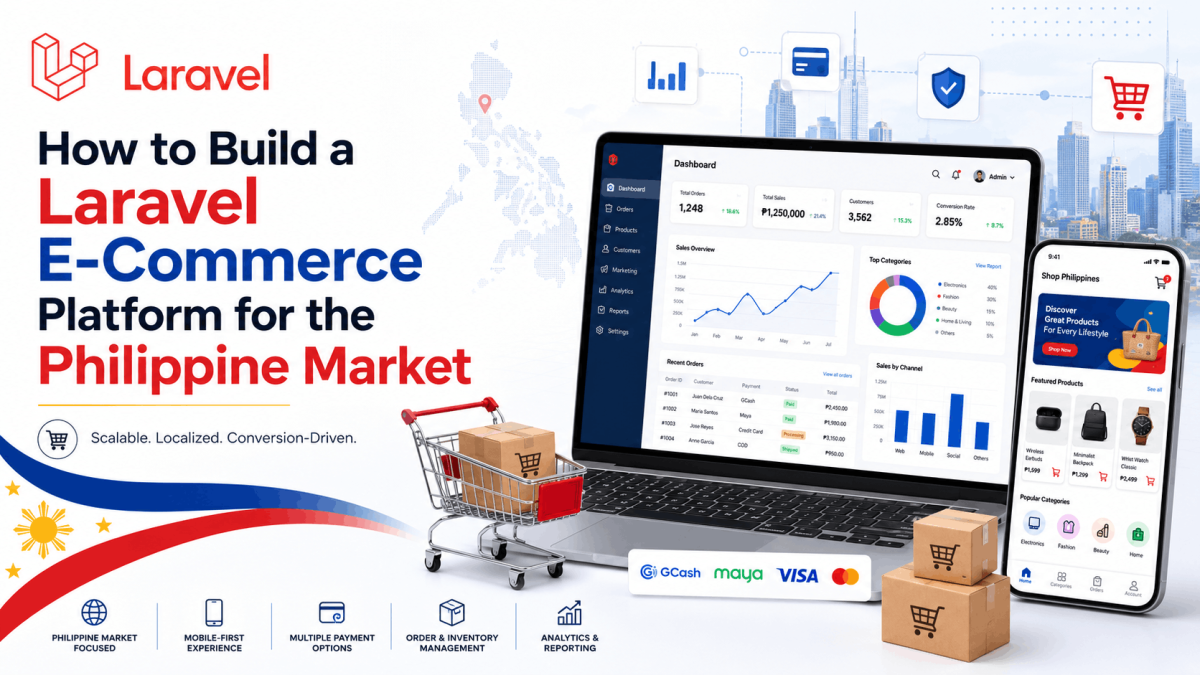
How to Build a Laravel E-Commerce Platform for the Philippine Market
E-commerce in the Philippines is no longer limited to large marketplaces and established retail companies. Startups, local retailers, wholesalers, manufacturers, restaurants, service providers, and growing SMEs are creating their own online commerce platforms to reach customers directly.
The Philippine digital economy generated approximately PHP 2.74 trillion in gross value added during 2025, representing 9.8 percent of the country’s gross domestic product. This was a 5.4 percent increase from the previous year, according to the Philippine Statistics Authority.
Digital payment adoption is also changing how consumers purchase products and services. Bangko Sentral ng Pilipinas reported that digital payments represented 57.4 percent of monthly retail payment transactions by volume in 2024, compared with 52.8 percent in 2023.
These developments create a strong opportunity for businesses that want to launch independent e-commerce platforms instead of relying entirely on third-party marketplaces.
However, building an e-commerce platform for the Philippines requires more than installing a shopping cart package. The system must account for local payment behavior, mobile users, delivery complexity, cash-on-delivery workflows, regional shipping rates, inventory operations, customer communication, security, and Philippine data privacy requirements.
Laravel provides a flexible foundation for building this type of custom commerce system. RuhaniSoft helps startups and businesses design, develop, integrate, launch, and maintain Laravel e-commerce platforms created specifically for the Philippine market.
Why Build a Custom Laravel E-Commerce Platform?
Businesses can choose from hosted e-commerce builders, marketplace accounts, open-source platforms, and fully custom applications. Each option has advantages, but a custom Laravel platform becomes valuable when the business has workflows that standard store builders cannot support efficiently.
A Laravel e-commerce platform can be designed around the company’s actual operating model rather than forcing the company to adapt its operations to a generic template.
Businesses may require custom development when they need:
- Multiple product types
- Complex inventory rules
- Wholesale and retail pricing
- Dealer or reseller accounts
- Custom delivery calculations
- Branch-level inventory
- Marketplace functionality
- Subscription products
- Installment payment workflows
- Service booking combined with product sales
- Custom approval processes
- Integration with an existing ERP, POS, or accounting system
- Mobile application APIs
- Advanced reports
Laravel gives the development team control over the database, business rules, integrations, administration system, APIs, checkout experience, and future product roadmap.
Why Laravel Is Suitable for Philippine E-Commerce
Flexible Business Logic
Philippine businesses do not all follow the same sales process.
A fashion store may need size and color variants. A grocery platform may need location-based inventory. A wholesaler may require minimum order quantities. A restaurant may need delivery zones and preparation times. A marketplace may need seller commissions and payout management.
Laravel allows developers to implement these rules directly in the application instead of depending on a limited plugin ecosystem.
Strong API Development
A modern e-commerce platform may serve several interfaces:
- Customer website
- Mobile application
- Administrative dashboard
- Vendor portal
- Warehouse interface
- Delivery application
- Point-of-sale system
Laravel can provide a centralized API layer for these interfaces. This keeps product, inventory, customer, order, and payment information synchronized across the complete commerce operation.
Secure Authentication and Permissions
An e-commerce application usually includes several user roles. Customers, administrators, warehouse employees, delivery personnel, sellers, accountants, and support agents should not have access to the same information.
Laravel supports authentication, authorization policies, middleware, API tokens, password security, session management, and role-based access control.
Queue and Background Processing
Commerce platforms perform many operations that should not delay the customer’s request.
Laravel queues can process:
- Order confirmation emails
- SMS notifications
- Invoice generation
- Inventory synchronization
- Payment webhook processing
- Image optimization
- Marketplace payouts
- Abandoned cart messages
- Shipping status updates
This improves application performance and makes high-volume operations more reliable.
Scalable Architecture
A business may begin with one store and later expand to multiple branches, warehouses, vendors, cities, or countries.
A properly designed Laravel application can grow through caching, queue workers, database optimization, load balancing, object storage, content delivery networks, cloud infrastructure, and modular application architecture.
Understand the Philippine Customer Before Development
Technology decisions should follow customer behavior and business requirements. The first stage of development should therefore focus on understanding how the intended customers browse, pay, receive orders, request support, and handle returns.
Mobile-First Shopping
The platform should be designed for mobile devices from the beginning.
A mobile-first commerce interface should include:
- Fast-loading product pages
- Large touch-friendly controls
- Simple navigation
- Readable product information
- Compressed product images
- Short checkout forms
- Address suggestions
- Persistent shopping carts
- Clear payment options
- Easy access to customer support
The platform should be tested on budget Android devices and slower mobile connections, not only on high-end phones and office internet connections.
Trust and Transparency
Customers need confidence before completing an online purchase.
The store should clearly display:
- Business information
- Product prices
- Available stock
- Delivery charges
- Estimated delivery times
- Payment methods
- Return and refund policies
- Customer service channels
- Order tracking information
- Privacy and security policies
Unexpected fees during checkout can increase cart abandonment. Shipping costs, service fees, discounts, taxes, and payment charges should be calculated and displayed clearly.
Guest Checkout
Forcing every customer to create an account can add friction to the purchasing process.
A Laravel store can support guest checkout while offering account creation after the order is complete. The system can associate previous guest orders with an account when the customer later registers using the same verified email address or phone number.
Define the E-Commerce Business Model
The application architecture will depend on what the business sells and how it operates.
Single-Vendor Store
A single-vendor store sells products owned or managed by one business. This is the most straightforward model.
Core modules usually include:
- Product catalog
- Inventory
- Shopping cart
- Checkout
- Payments
- Orders
- Shipping
- Returns
- Customer accounts
- Administration
Multi-Vendor Marketplace
A marketplace allows multiple merchants or service providers to sell through the platform.
Additional modules may include:
- Seller registration
- Seller verification
- Vendor dashboards
- Product approval
- Commission rules
- Seller subscriptions
- Split order management
- Seller payouts
- Dispute management
- Vendor performance reports
Business-to-Business Commerce
A B2B Laravel platform may require features that are not common in consumer stores.
These can include:
- Company accounts
- Multiple buyers under one organization
- Negotiated price lists
- Volume discounts
- Minimum order quantities
- Purchase orders
- Credit limits
- Approval workflows
- Request-for-quotation functionality
- Recurring orders
Omnichannel Commerce
An omnichannel platform connects online orders with physical stores, warehouses, social commerce, POS systems, and customer support channels.
Inventory and order information must be synchronized to prevent overselling and inconsistent records.
Plan the Laravel E-Commerce Architecture
A commerce application should be organized into clear business modules. Placing all logic inside controllers creates a system that becomes difficult to test and maintain.
A scalable Laravel architecture may include:
- Controllers for receiving requests
- Form request classes for validation
- Service classes for business operations
- Repositories or query classes for complex data access
- Policies for authorization
- Events and listeners for decoupled workflows
- Jobs for background processing
- API resources for consistent responses
- Domain-specific modules for major commerce functions
Major modules can include catalog, pricing, customers, carts, checkout, payments, inventory, orders, shipping, promotions, returns, notifications, and reporting.
Design the Product Catalog
The product catalog is one of the most important parts of the platform.
Product Information
A product record may contain:
- Name
- Slug
- SKU
- Barcode
- Short description
- Detailed description
- Category
- Brand
- Images
- Regular price
- Sale price
- Cost
- Weight
- Dimensions
- Tax classification
- Shipping requirements
- Publication status
- SEO metadata
Product Variants
Variants should be modeled separately instead of storing size and color combinations as unstructured text.
Each variant may have its own:
- SKU
- Barcode
- Price
- Stock quantity
- Image
- Weight
- Availability status
This structure makes inventory tracking, filtering, reporting, and order processing more reliable.
Categories and Attributes
Products should support categories, subcategories, brands, tags, specifications, and filterable attributes.
The attribute system should be flexible enough to support different product categories. Mobile phones may need storage and screen size, while clothing may require material, size, gender, and color.
Build Reliable Inventory Management
Inventory errors can create cancelled orders, dissatisfied customers, and financial losses.
Stock Movements
Instead of updating a single stock number without history, the application should record stock movements.
A movement may represent:
- Purchase receiving
- Customer order allocation
- Order cancellation
- Return
- Damage
- Manual adjustment
- Warehouse transfer
- Promotional distribution
This creates an auditable inventory trail.
Multiple Warehouses and Branches
Businesses operating in Luzon, Visayas, and Mindanao may need inventory across several fulfillment locations.
The system should identify which warehouse can fulfill an order based on stock availability, delivery location, cost, and operational rules.
Stock Reservation
The application may reserve inventory when a customer begins payment or confirms an order. Reservations should expire after a defined period when payment is not completed.
This reduces overselling during promotions and high-traffic campaigns.
Create a Philippine-Friendly Checkout
The checkout should collect only information required to process the order.
Address Structure
The delivery address model should support Philippine location data, including:
- Region
- Province
- City or municipality
- Barangay
- Postal code
- Street address
- Landmark
- Recipient name
- Mobile number
Location data should be normalized where possible. Structured address fields make shipping calculations, reporting, delivery routing, and service-area validation easier.
Checkout Steps
A practical checkout flow may include:
- Review cart
- Enter or select delivery address
- Select shipping method
- Choose payment method
- Review the complete order total
- Confirm the order
- Complete payment when required
The checkout should preserve customer information when a payment attempt fails so that the customer does not need to repeat the complete process.
Integrate Appropriate Payment Methods
Payment integration should be selected according to the business model, average order value, customer profile, settlement requirements, fees, supported currencies, refund capabilities, and technical documentation.
Digital Wallets and Online Payments
The platform may integrate payment providers that support cards, bank transfers, QR-based payments, or popular digital wallets available to Philippine customers.
The final provider selection should be based on the provider’s current merchant eligibility, API support, pricing, settlement schedule, dispute handling, and compliance requirements.
Cash on Delivery
Cash on delivery may remain necessary for some product categories and customer segments.
However, COD is not simply a payment button. The system needs operational controls for:
- Order verification
- Fraud prevention
- Delivery attempt tracking
- Failed deliveries
- Return-to-sender costs
- Courier remittance
- COD reconciliation
- Customer restrictions after repeated refusals
Payment Webhooks
The application should not rely only on the customer being redirected back to the website after payment.
Payment providers normally send server-to-server webhook notifications. Laravel should validate the webhook signature, confirm the transaction with the provider when necessary, prevent duplicate processing, log the event, and update the order safely.
Idempotent Payment Processing
Payment callbacks may be delivered more than once. The system must ensure that the same successful transaction does not create duplicate payments, invoices, inventory deductions, or fulfillment requests.
Each provider transaction should have a unique identifier and an idempotent processing workflow.
Develop Flexible Philippine Shipping Management
Shipping is one of the most complex parts of Philippine e-commerce because delivery costs and service availability can vary by island, province, city, barangay, parcel size, and courier.
Shipping Zones
The platform should allow administrators to create shipping zones based on geographic areas.
A zone may define:
- Supported locations
- Base delivery fee
- Additional weight charges
- Free-shipping threshold
- Estimated delivery period
- Available couriers
- Cash-on-delivery availability
Courier Integration
When a courier provides a suitable API, the Laravel platform may automate:
- Rate calculation
- Shipment creation
- Waybill generation
- Pickup requests
- Tracking updates
- Delivery confirmation
- COD reconciliation
The integration should include logging and retry mechanisms because external courier services can occasionally become unavailable.
Manual Shipping Operations
Not every logistics provider offers a complete API. The administration system should therefore support manual shipment creation, tracking number entry, courier assignment, status updates, and proof-of-delivery records.
Implement Order Management
An order should have a controlled lifecycle rather than an unrestricted text status.
Possible statuses include:
- Pending confirmation
- Awaiting payment
- Paid
- Processing
- Packed
- Ready for pickup
- Shipped
- Out for delivery
- Delivered
- Cancelled
- Return requested
- Returned
- Refunded
Status transitions should follow defined rules. For example, an unpaid order should not normally move directly to delivered, and a refund should reference the related payment transaction.
Order History
The application should record who changed an order, what was changed, when it happened, and any related notes.
This history helps customer support teams investigate disputes and operational errors.
Support Promotions Without Creating Pricing Errors
Promotions can increase sales, but an unstructured discount system can create serious financial problems.
The promotion engine may support:
- Percentage discounts
- Fixed-value discounts
- Free shipping
- Product-specific offers
- Category discounts
- Minimum purchase requirements
- First-order discounts
- Customer-group pricing
- Buy-one-get-one offers
- Limited coupon usage
- Campaign start and end dates
The application should define whether promotions can be combined and which discount receives priority when multiple offers apply.
Build Returns and Refund Management
A professional commerce platform needs a clear process for returns, replacements, cancellations, and refunds.
A return workflow may include:
- Customer submits a return request
- Customer selects the affected item and reason
- Customer uploads supporting images when necessary
- Support team reviews the request
- Return is approved or rejected
- Pickup or customer shipment is arranged
- Warehouse inspects the returned product
- Refund, replacement, or store credit is processed
The system should distinguish between full and partial refunds and maintain a record of payment-provider refund identifiers.
Comply With Philippine Data Privacy Requirements
An e-commerce platform processes names, addresses, mobile numbers, email addresses, order histories, device information, support messages, and payment-related data.
The Philippine Data Privacy Act of 2012 applies to personal information processed by private-sector information and communication systems. The National Privacy Commission’s implementing rules require organizations to safeguard personal information while respecting data-subject rights.
The National Privacy Commission has also specifically warned online sellers against unauthorized processing, disclosure, and improper disposal of customer information.
A Laravel e-commerce platform should therefore include appropriate technical and organizational controls.
Privacy Requirements to Consider
- Clear privacy notice
- Defined purpose for data collection
- Collection of only necessary information
- Consent management where required
- Secure storage and transmission
- Restricted employee access
- Data retention policies
- Customer data access and correction procedures
- Account deletion or data request workflows where applicable
- Incident response procedures
- Third-party processor agreements
Businesses should obtain appropriate Philippine legal and privacy advice for their exact obligations. Application development can implement required controls, but it does not replace legal assessment.
Secure the Laravel E-Commerce Platform
Protect Administrative Accounts
Administrative access should support strong passwords, two-factor authentication, login rate limiting, session expiration, and permission-based controls.
Validate Every Request
Prices, discounts, shipping fees, taxes, and order totals must be calculated on the server. The application should never trust values submitted by the customer’s browser.
Avoid Storing Raw Card Information
Payment card information should be handled by properly selected payment providers. The e-commerce platform should avoid storing raw card numbers or security codes.
Log Sensitive Operations
The system should record important activities such as:
- Administrator logins
- Price changes
- Inventory adjustments
- Order cancellations
- Refund approvals
- Permission changes
- Customer data exports
Maintain Dependencies
Laravel, PHP, JavaScript packages, server software, and third-party integrations should be updated regularly. Unsupported software can create security and compatibility risks.
Optimize Performance for Philippine Users
Performance directly affects shopping experience and conversion.
Optimize Product Images
Product images should be resized, compressed, and delivered in modern formats when supported. The application should generate different image dimensions for thumbnails, listings, carts, and product details.
Use Caching
Laravel caching can improve category pages, product details, configuration settings, shipping rules, and other frequently requested data.
Move Heavy Tasks to Queues
Email delivery, image processing, report generation, data synchronization, and webhook retries should run through background workers.
Optimize Database Queries
The development team should monitor slow queries, prevent unnecessary repeated queries, create suitable indexes, and paginate large datasets.
Use a Content Delivery Network
A CDN can serve images, stylesheets, scripts, and other static resources from locations closer to the customer.
Develop a Practical Administration Dashboard
The administration interface should help employees operate the business efficiently.
Core administrative capabilities may include:
- Product management
- Category and brand management
- Inventory monitoring
- Order processing
- Payment reconciliation
- Shipment management
- Customer management
- Promotion management
- Return and refund processing
- Content management
- Reports
- Role and permission management
- System configuration
Dashboards should prioritize actionable information, including pending orders, low-stock products, failed payments, overdue shipments, return requests, and operational exceptions.
Track the Right E-Commerce Metrics
The platform should collect data that helps the business make decisions.
Useful metrics include:
- Total sales
- Number of orders
- Average order value
- Conversion rate
- Cart abandonment rate
- Payment success rate
- Cash-on-delivery failure rate
- Return rate
- Refund value
- Repeat purchase rate
- Sales by region
- Sales by product
- Sales by channel
- Delivery performance
- Inventory turnover
Reports should use the same transactional data as the order and payment systems to prevent inconsistent numbers.
Test the Complete Customer Journey
Testing should cover more than individual pages.
The quality assurance team should test complete workflows, including:
- Customer registration
- Guest checkout
- Product variant selection
- Coupon application
- Online payment
- Failed payment recovery
- Cash-on-delivery checkout
- Inventory reservation
- Order cancellation
- Shipment creation
- Return requests
- Partial refunds
- Mobile responsiveness
- Permission restrictions
Automated tests are particularly valuable for prices, discounts, inventory, payments, shipping calculations, and order status transitions.
Recommended Development Phases
Phase 1: Product Discovery
Define the business model, user roles, sales workflow, payment methods, shipping process, integrations, reporting requirements, and MVP scope.
Phase 2: User Experience and Technical Design
Create customer journeys, wireframes, database structures, API plans, application architecture, and technical acceptance criteria.
Phase 3: Core Commerce Development
Build the product catalog, inventory, shopping cart, checkout, customer accounts, administration, and order management.
Phase 4: Payment and Logistics Integration
Integrate approved payment methods, shipping providers, notifications, and operational reconciliation workflows.
Phase 5: Testing and Security Review
Test customer journeys, integrations, performance, permissions, privacy controls, and failure scenarios.
Phase 6: Launch
Configure production infrastructure, monitoring, backups, domains, email delivery, queue workers, scheduled tasks, and deployment automation.
Phase 7: Continuous Improvement
Review customer behavior, support requests, abandoned carts, performance metrics, and operational challenges. Use this information to prioritize future development.
Common Mistakes to Avoid
Copying a Generic Foreign Store
A platform designed for another country may not support Philippine address formats, payment behavior, shipping complexity, and customer expectations.
Building Too Many Features Before Launch
The first release should cover the essential commerce journey. Secondary features can be developed after the business begins collecting customer and operational feedback.
Ignoring Cash-on-Delivery Operations
COD requires verification, fulfillment, tracking, remittance, failed-delivery management, and reporting. Treating it as a simple checkout choice creates operational problems.
Depending Entirely on Plugins
Packages can accelerate development, but critical commerce logic should remain understandable and maintainable. The team should evaluate package quality, updates, security, licensing, and compatibility.
Using One Status for Everything
Payment, fulfillment, shipment, return, and refund statuses represent different processes. Combining them into one status field limits reporting and creates workflow confusion.
Launching Without Monitoring
The production environment should monitor application errors, failed queue jobs, payment webhooks, server resources, backups, and critical business operations.
How RuhaniSoft Builds Laravel E-Commerce Platforms
RuhaniSoft provides custom Laravel and PHP development services for startups, SMEs, retailers, wholesalers, marketplaces, and digital businesses targeting the Philippine market.
We focus on building commerce systems that match the client’s actual operational requirements rather than delivering a generic storefront with minor visual changes.
E-Commerce Product Discovery
RuhaniSoft can help define:
- Business model
- Customer groups
- Product structure
- Checkout requirements
- Payment methods
- Delivery operations
- Inventory workflow
- Administration roles
- Required integrations
- MVP priorities
Custom Laravel Commerce Development
Our Laravel development services can include:
- Custom storefront development
- Product catalog systems
- Shopping cart and checkout
- Payment gateway integration
- Cash-on-delivery workflows
- Order management
- Shipping integrations
- Inventory and warehouse management
- Multi-vendor marketplaces
- B2B commerce portals
- Customer and vendor dashboards
- Mobile application APIs
- Reports and analytics
Existing Platform Modernization
RuhaniSoft can also review an existing Laravel or PHP commerce application and help resolve problems such as outdated dependencies, slow performance, poor architecture, payment failures, inventory inconsistencies, security concerns, or unfinished modules.
Dedicated Laravel Developers
Philippine businesses with internal product managers or technical teams can hire dedicated Laravel developers through RuhaniSoft.
Our developers can work within the client’s repository, task management system, sprint process, coding standards, and release workflow.
Ongoing Maintenance
An e-commerce platform requires continuous technical attention after launch.
RuhaniSoft provides ongoing services for:
- Bug fixes
- Laravel upgrades
- Security updates
- Performance optimization
- Payment integration maintenance
- Courier API maintenance
- New feature development
- Infrastructure improvements
- Technical support
Build a Philippine E-Commerce Platform With RuhaniSoft
A successful Philippine e-commerce platform must combine customer convenience with dependable business operations.
The system should provide a fast mobile experience, appropriate payment choices, structured address collection, flexible delivery rules, accurate inventory, secure order processing, transparent customer communication, and privacy-conscious data management.
Laravel provides the flexibility required to develop these capabilities while maintaining control over the source code, architecture, integrations, and future roadmap.
RuhaniSoft helps Philippine startups and businesses build custom Laravel e-commerce platforms that are designed for local market requirements and prepared for long-term growth.
Whether you need a single-vendor online store, a multi-vendor marketplace, a wholesale ordering platform, an omnichannel retail system, or a mobile commerce backend, RuhaniSoft can provide the Laravel development expertise required to plan and deliver the platform.
Visit ruhanisoft.com to discuss your Philippine e-commerce platform, Laravel development requirements, payment integrations, or dedicated offshore development team.