
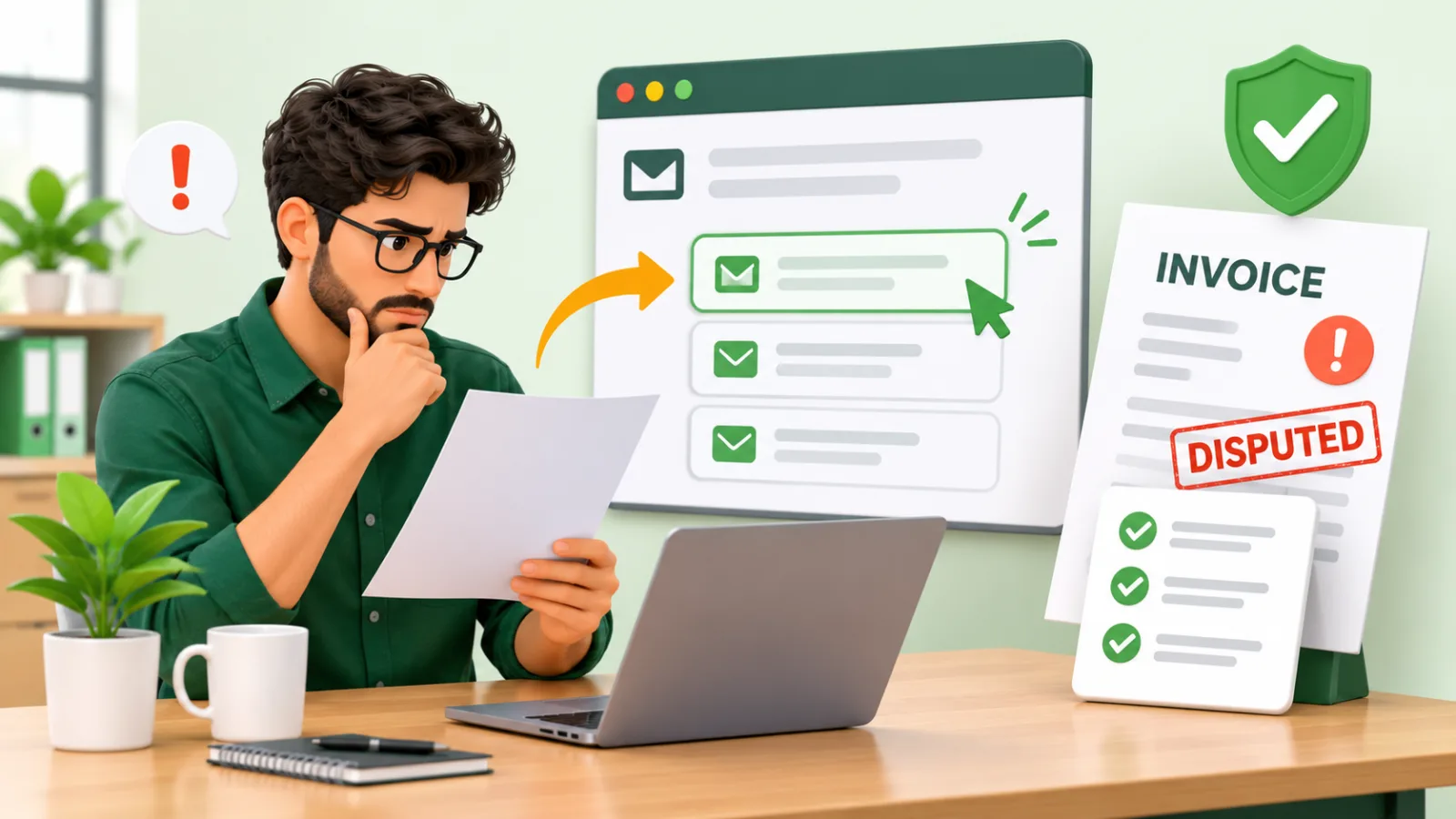
You send a reminder about an overdue invoice and the reply is not "payment is on its way." It is "we don't agree with this." For a freelancer or small agency, that moment is stressful, and a rushed reply can make things worse. A calm, structured response, often built from a reliable disputed invoice email template, keeps the relationship intact and moves the conversation toward payment.
This guide walks through what to do in order: acknowledge the dispute, check the contract and your delivery evidence, confirm what is not in dispute, and agree next steps. You will find three emails you can copy and adapt. If you need standard reminders for invoices that are late but not contested, our article on overdue invoice email templates covers that situation.
First, understand what kind of dispute this is
Not every dispute is the same, and your reply depends on the type. Most fall into a few groups:
- Scope disagreement: the client believes an item was included in the original price, or was never agreed.
- Quality or acceptance: the client says the work does not meet expectations or has defects.
- Billing error: wrong hours, wrong rate, duplicate line, wrong purchase order number or wrong entity.
- Timing or cash flow: the client calls it a dispute, but the real issue is that they cannot pay yet.
- Internal confusion: the person who approved the work is not the person processing invoices.
You often cannot tell which one it is from the first message. That is fine. Your first job is not to win the argument. It is to find out exactly what the client is objecting to.
Step 1: Acknowledge the dispute quickly and neutrally
Reply within one business day if you can. A fast, polite acknowledgment shows you take the concern seriously and prevents the client from feeling ignored, which is a common reason small disagreements escalate.
A good acknowledgment does four things:
- Thanks them for raising the issue.
- Restates the dispute in your own words so they can correct you.
- Asks for any missing detail, such as which line items they question.
- Gives a date by which you will respond with findings.
Avoid defensive phrases like "as I already told you" or "per our agreement, you clearly owe." Avoid threats as well. You may need to escalate later, but the first reply should keep every door open.
Email 1: Acknowledging the dispute
Subject: Invoice [number] – received your query
Hi [Name],
Thank you for letting me know about invoice [number] for [amount], originally due on [date]. I understand you have a concern about [describe the issue as you understand it].
I want to make sure I understand it correctly and resolve it properly. Could you tell me which line items or deliverables you are questioning, and what you expected instead?
In the meantime, I will review the agreement and the delivery records for this project, and I will come back to you by [date] with what I find.
Thanks,
[Your name]
[Business name]
Step 2: Check the contract and delivery evidence
Before you reply with any position, gather the facts. This step is where many freelancers skip ahead and later regret it. You may discover that the client is partly right, or that your own records are thinner than you assumed.
What to check in the contract or proposal
- The agreed scope, deliverables and any exclusions.
- Pricing model: fixed price, hourly, milestone or retainer.
- The change request process, if there is one, and whether the disputed work went through it.
- Acceptance or review terms, such as how long the client had to give feedback.
- Payment terms written in the agreement, including due dates.
Read these as written, not as you remember them. If the document is ambiguous, note that honestly. Ambiguity is a reason to negotiate, not to insist.
What to gather as delivery evidence
- Emails or messages where the client requested or approved the work.
- Delivery records: release notes, file handovers, staging links, deployment dates.
- Timesheets or task logs that match the hours invoiced.
- Client feedback, sign-offs or review comments.
- Previous invoices that were paid for similar work.
Put these in a short internal summary: what was agreed, what was delivered, what was invoiced, and where the gaps are. If you made an error, such as a duplicate line or a wrong rate, plan to correct it plainly and issue a revised invoice or credit note.
If the dispute involves contract interpretation or the possibility of legal action, speak to a qualified professional in your jurisdiction. This article covers communication practice, not legal advice.
Step 3: Confirm the undisputed amount
A dispute about one line item should not freeze payment on the whole invoice. Once you understand what the client is questioning, identify the portion they do not contest and ask for it to be paid on the original schedule or a clearly stated date.
For example, if an invoice has five items and the client only questions one, the other four are likely not in dispute. Ask the client to confirm that. Get it in writing, even if it is a one-line reply.
Be careful with wording. Do not claim a late fee unless your signed agreement or invoice terms clearly state one and you are confident it applies. If the contract mentions late charges, you can refer to it neutrally, but do not invent rules or quote amounts you cannot back up. Many small businesses recover payment faster by being reasonable than by adding penalties in the middle of a disagreement.
Email 2: Sharing findings and confirming the undisputed amount
Subject: Invoice [number] – findings and undisputed amount
Hi [Name],
Thanks for your patience while I reviewed invoice [number]. Here is what I found.
Agreed and delivered: [list items], totaling [amount]. These were [approved on date / delivered on date], and I have attached the relevant [emails / delivery notes / timesheets].
Under review: [item], totaling [amount]. [Explain briefly: what the agreement says, what was delivered, or what you corrected.]
Based on this, could you confirm that [undisputed amount] is not in question and let me know when it will be paid? I am happy to talk through the remaining item on a short call if that is easier.
Thanks,
[Your name]
[Business name]
If you found a mistake on your side, replace the "under review" paragraph with something like: "I found an error in how [item] was billed. I have attached a corrected invoice for [new amount]. Apologies for the confusion." Owning an error quickly builds credibility for the rest of your invoice.
Step 4: Agree next steps in writing
A disagreement drifts when nobody owns the next action. Close each exchange with a specific outcome, an owner and a date. Options include:
- Pay as invoiced: the client reviews your evidence and agrees.
- Corrected invoice: you fix an error and set a new due date.
- Partial payment now: the undisputed part is paid while the rest is discussed.
- Short call or meeting: both sides walk through the scope and deliverables, then confirm the outcome by email.
- Compromise on the disputed item: a reduced amount, a credit against future work, or a follow-up fix at no charge. Only offer what you are comfortable with, and record it clearly.
- Payment plan: if the issue is cash flow, agree on specific dates and amounts.
After any call, send a short written recap. It prevents misunderstandings about what each side said.
Email 3: Agreeing next steps after a discussion
Subject: Invoice [number] – agreed next steps
Hi [Name],
Thanks for taking the time to talk today. To keep things clear, here is what we agreed:
- [Undisputed amount] will be paid by [date].
- For [disputed item], we agreed to [corrected invoice / reduced amount / further review / additional fix], and I will send this by [date].
- [Any other action, with owner and date.]
If I have missed or misunderstood anything, please reply and let me know. Otherwise, I will proceed as above.
Thank you again for working through this with me.
Best,
[Your name]
[Business name]
Mistakes to avoid
- Going silent: delays make the client assume you have no answer.
- Arguing by phone only: you need a written trail of what was said and agreed.
- Mixing issues: keep scope, quality and payment timing as separate topics.
- Overloading with attachments: send the evidence that matters, with a sentence explaining why.
- Withholding future work as a threat: if you pause work, base it on your agreement and state it calmly and factually.
- Forgetting to follow up: if the client promised a reply by Friday, check on Monday.
Make follow-up easier with the right tools
Disputes are harder when your records are scattered. Keep proposals, change requests, approvals and timesheets in one place for each client. Send invoices that describe the work clearly, so a line like "Development – 12 hours" becomes "Checkout page revisions, 12 hours, approved [date]."
Consistent follow-up also matters. A tool such as Dueping can help you keep track of unpaid invoices and send reminders on schedule, so a dispute does not sit unnoticed while the due date slips. Pair that with the templates above, and you can respond quickly without rewriting every message from scratch.
Prevent the next dispute
Most invoice disputes trace back to unclear expectations at the start. A few habits reduce them:
- Write a scope that lists deliverables and what is excluded.
- Use a change request note whenever the work grows.
- Ask for written approval at milestones.
- Send invoices promptly, while the work is fresh in the client's mind.
- State payment terms clearly on every proposal and invoice.
These steps take little time and give you something concrete to point to if a disagreement does arise. The SBA guide to managing a business is a useful companion.
Conclusion
A disputed invoice does not have to turn into a standoff. Acknowledge the concern quickly, check what was agreed and delivered, separate the undisputed amount from the contested part, and close with clear next steps. The three emails above give you a starting point you can adapt to your tone and your client.
At RuhaniSoft, we build custom software, web and mobile apps, and AI solutions with clear scopes, milestones and documentation so projects stay on track and billing stays straightforward. If you are planning a software project and want a delivery process that avoids these surprises, talk to us about what you need.