
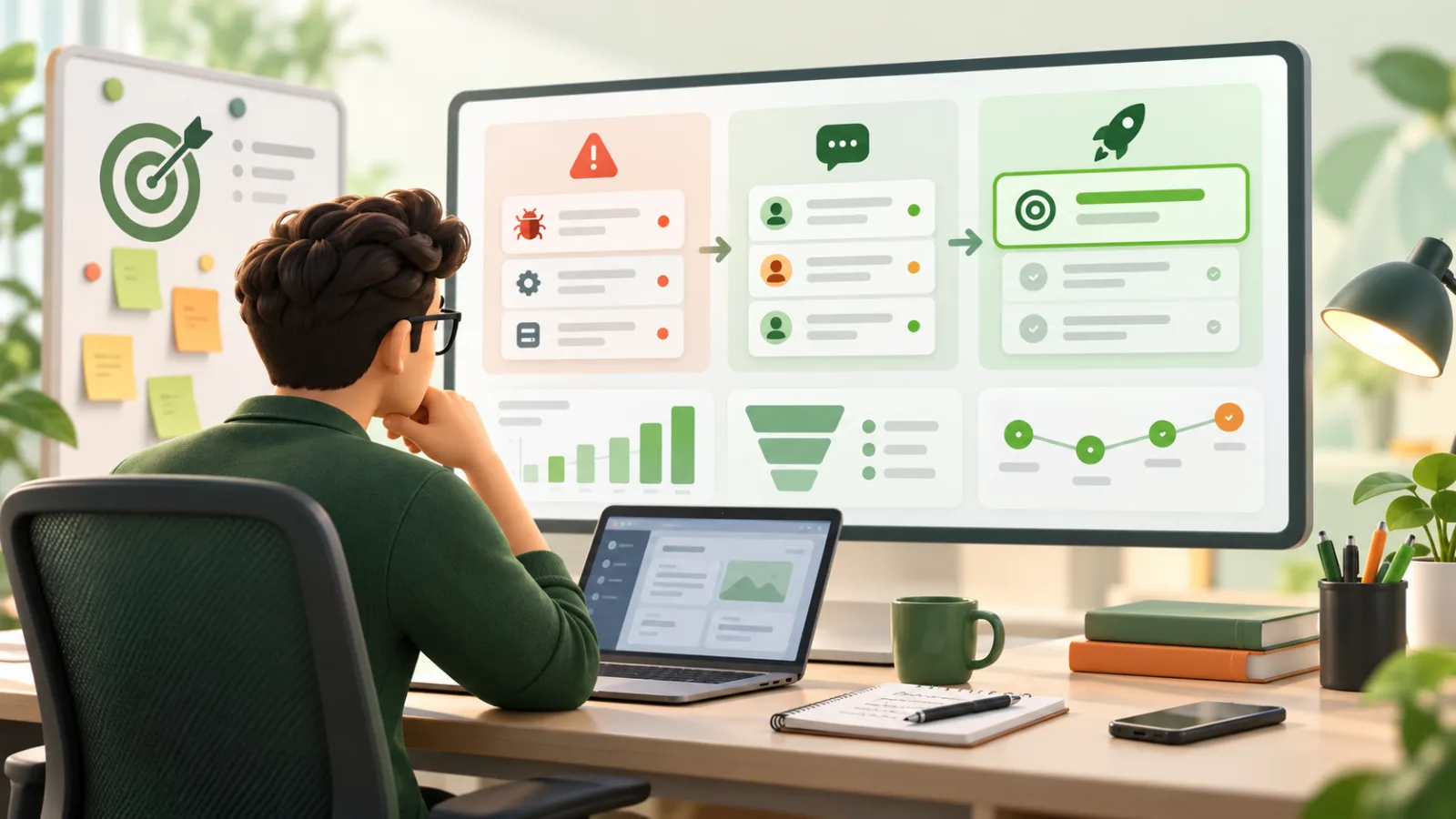
After an MVP launch, the immediate challenge is deciding what the product has taught you and what deserves attention next. User requests, support questions, defects and new business ideas can all arrive together. Treating them as one undifferentiated feature backlog makes it difficult to protect the product's original purpose.
This guide is for founders and product teams with a working first release. If you are still defining that release, start with MVP planning, compare an MVP with a full product, and explore our MVP development services.
Revisit the question the first release was meant to answer
Write down the original target user, problem and core task. Then identify the evidence the release was intended to collect. Without that reference, an active inbox can look like progress even when the product is drifting into unrelated work.
Separate observations from interpretations. "Several invited users stopped before completing setup" is an observation worth investigating. "We need a completely different product" is a decision that needs more context.
Review the examples with the person who owns product decisions. If the user journey itself is unclear, return to the requirements document rather than asking a developer to infer a new direction from individual comments.
Separate operational problems from product requests
A broken agreed workflow, an access issue and a request for a new dashboard should not automatically have the same priority. Classify incoming work so the team understands what type of decision is needed.
| Work type | Useful next question |
|---|---|
| Defect | Does the product fail behaviour already agreed for the release? |
| Operational issue | Does someone need to restore or investigate normal service? |
| Usability feedback | Can the intended user understand and complete the current task? |
| Product request | Does this add behaviour outside the accepted scope? |
| Technical upkeep | What maintenance is needed to continue operating the application? |
The categories help discussion; they do not replace judgement about impact. Record the affected users, reproducible steps and any available evidence before assigning work.
For a broader view of delivery expectations, read why software projects fail. Unclear responsibilities after launch can recreate the same problems that arise during the build.
Combine feedback with evidence from the core journey
Use conversations, support records and whatever product measurement is already appropriate to the application. Agree what a completed core task means and avoid collecting information merely because a tool makes it available.
Ask users about what they were trying to achieve and where they became uncertain. A requested feature may be one person's proposed solution to a problem that has a simpler answer.
Look for context before treating a request as a roadmap commitment. Was the person part of the intended audience? Did they attempt the central task? Is the issue preventing use or making a secondary activity less convenient? An MVP supplies evidence for these decisions; it does not guarantee demand.
Choose a next release with one clear purpose
Group related problems and choose a release goal that can be explained in a sentence. Examples might include making first-time setup understandable or allowing staff to resolve an important exception without developer help.
Define the acceptance criteria, exclusions and owner for each selected item. Keep additional ideas in the backlog rather than allowing them to enter the release through informal messages.
The MVP development cost guide helps frame the next estimate around actual scope. For a product that is developing into a wider platform, review custom software development and its cost-planning guide before expanding several connected workflows at once.
Choose an engagement that fits the backlog
A defined release suits a clear group of changes and a reviewable outcome. Continuing development may suit a backlog that changes as users respond. Confirm who prioritises tasks, who reviews implementation and who approves a release under either model.
If an internal product owner already manages a Laravel application, hiring a Laravel developer may fit the need for additional capacity. If several roles must be coordinated, compare a dedicated software team with the other options in our team model guide.
The contract shape should follow the work. Do not assume that moving to an ongoing engagement removes the need for acceptance criteria or visible review.
Keep maintenance and product development visible
Confirm who owns hosting, backups, account access, dependency updates and incident investigation. Record which support activities are included in the agreement and which require additional scope.
Maintain a short operational guide with configuration needs, deployment steps, known limitations and the people responsible for important systems. Read the software maintenance cost guide to keep these recurring responsibilities separate from new features.
If the product includes a mobile app, operating-system compatibility and distribution work need attention alongside the backend. Our mobile app development service describes the wider product work around the device experience. The development approach provides a framework for reviewing and handing over each release.
Frequently asked questions
Should we build every feature users request?
No. Investigate the underlying problem, the affected audience and its relationship to the product goal. Some feedback points to a defect or unclear existing behaviour rather than a missing feature.
When should an MVP become a larger product?
There is no universal feature count or date. Review whether the intended users can obtain value, which assumptions remain uncertain and what operational responsibilities growth would introduce. A larger build should follow a reasoned product decision.
What should we share with a development partner after launch?
Bring the current application context, a prioritised problem list, examples of user feedback and the person who will approve work. Avoid treating a collection of unreviewed messages as a final specification.
Plan the next release around what you learned
RuhaniSoft can discuss a defined product milestone or ongoing development support. Share the original MVP goal, what users have tried and the most important issue now. Start a post-launch product conversation to agree on the information needed for the next scope.