
Introduction
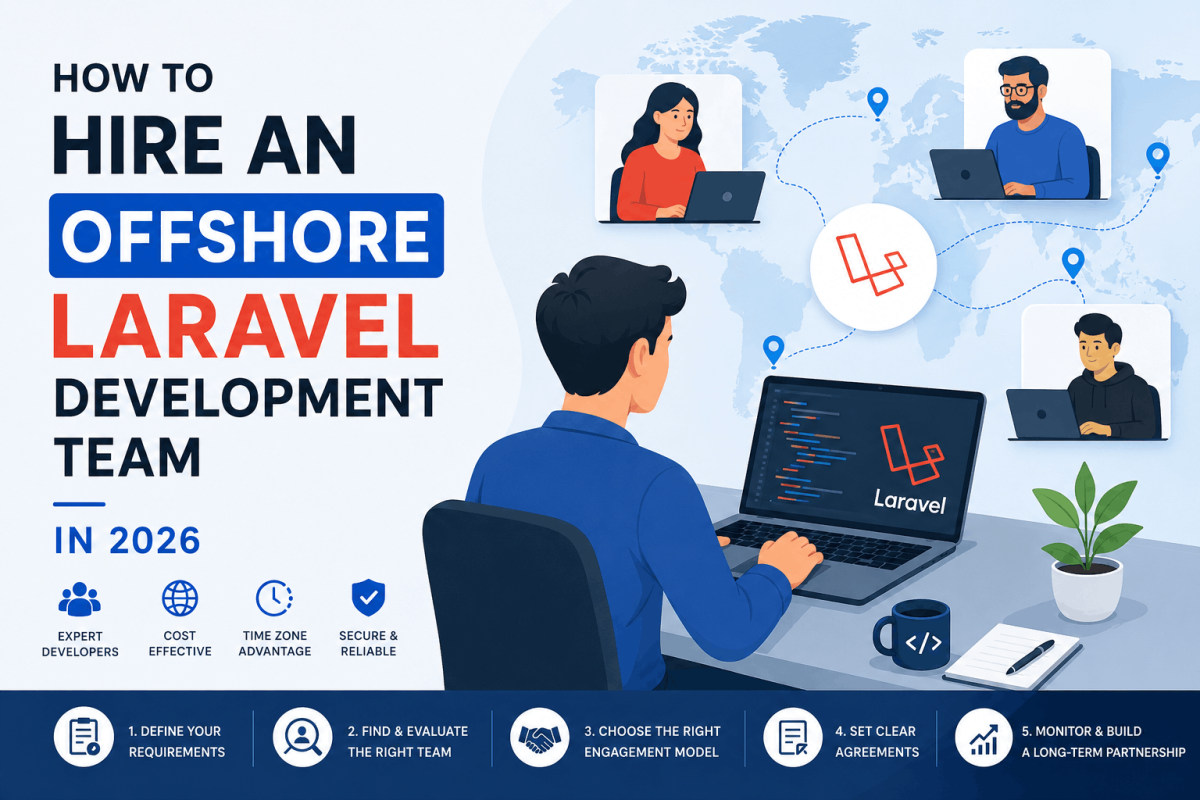
Hiring an offshore Laravel development team can help your business build software faster, access specialized technical expertise, and control development costs. However, choosing the right team requires more than comparing hourly rates or reviewing a few portfolio links.
In 2026, Laravel projects are becoming more complex. Businesses expect secure APIs, cloud infrastructure, subscription billing, real-time features, automated testing, mobile integrations, and scalable application architecture. Your offshore team must therefore understand both Laravel development and the business systems surrounding it.
This guide explains how to hire an offshore Laravel development team, evaluate potential partners, select the right engagement model, and avoid common outsourcing problems.
What Is an Offshore Laravel Development Team?
An offshore Laravel development team is a group of developers located in another country that works remotely on your Laravel application. The team may include:
- Laravel backend developers
- Frontend developers
- UI and UX designers
- Quality assurance engineers
- DevOps engineers
- Project managers
- Technical leads
You can hire offshore developers through a software development agency, a dedicated team provider, or a group of independent freelancers.
For ongoing products and business-critical applications, working with an established Laravel development company is usually more reliable than assembling several unrelated freelancers.
Why Businesses Hire Offshore Laravel Teams in 2026
Access to Specialized Laravel Expertise
Finding experienced Laravel developers locally can be difficult, especially when you need knowledge of advanced technologies such as Laravel Octane, Laravel Horizon, Livewire, Inertia.js, Redis, queues, multi-tenancy, or complex third-party integrations.
Offshore hiring gives businesses access to a broader international talent pool without being limited to developers available in one city or country.
Lower Development Costs
Offshore teams often operate in regions with lower business and employment costs. This allows companies to hire experienced developers at a more manageable cost than building an equivalent internal department.
The objective should not be to find the cheapest team. The objective should be to obtain the best combination of technical quality, reliability, communication, and cost.
Faster Team Expansion
Recruiting local developers can take several months. An offshore Laravel company may already have developers, designers, testers, and project managers available to begin work.
This is particularly useful for startups that need to launch quickly or agencies that need additional capacity for client projects.
Flexible Engagement Models
Offshore Laravel teams typically offer several engagement options, including:
- Fixed-price project development
- Dedicated monthly developers
- Hourly development support
- Team extension
- Maintenance and support contracts
This flexibility allows businesses to increase or reduce development capacity according to project requirements.
Extended Working Coverage
Time-zone differences can create longer development coverage when managed correctly. Your internal team can prepare feedback during its working hours, while the offshore team handles implementation during another part of the day.
However, overlapping working hours are still necessary for meetings, issue resolution, and project coordination.
Define Your Laravel Project Requirements First
Before contacting Laravel development teams, prepare a clear summary of what you want to build.
Your initial project document should include:
- The business problem your application will solve
- Your target users
- Required application modules
- User roles and permissions
- Third-party integrations
- Preferred frontend technology
- Expected launch timeline
- Estimated budget range
- Existing codebase information
- Hosting or infrastructure requirements
You do not need a complete technical specification before speaking with a development company. However, a clear business overview will help potential teams provide more accurate recommendations and estimates.
Separate Essential and Optional Features
Divide your requirements into three categories:
- Essential features required for the first release
- Important features that can be added after launch
- Optional ideas that require further validation
This prevents the initial scope from becoming unnecessarily large and makes it easier to build a focused minimum viable product.
Choose the Right Offshore Engagement Model
Fixed-Price Development
Under a fixed-price model, the development company agrees to complete a defined scope for an agreed price and timeline.
This model is suitable when:
- The project requirements are clear
- The design and workflows are already documented
- Changes are unlikely during development
- You need predictable costs
The main limitation is reduced flexibility. Any new feature or workflow change may require a separate estimate and change request.
Dedicated Laravel Developer
A dedicated developer works exclusively or primarily on your project for a monthly fee.
This model is suitable when:
- You have ongoing development work
- The requirements may change regularly
- You already have internal product management
- You need direct access to the developer
A dedicated developer can become deeply familiar with your product, but you may still need additional expertise for design, testing, infrastructure, or architecture.
Dedicated Laravel Development Team
A dedicated team may include multiple Laravel developers, frontend engineers, testers, designers, and a project manager.
This model works well for:
- Large SaaS applications
- Long-term product development
- Complex business platforms
- Projects requiring continuous feature releases
- Companies without a complete internal technical team
The dedicated team model provides more flexibility than fixed-price development while offering better coordination than hiring separate freelancers.
Hourly Development Support
Hourly support is useful for maintenance tasks, bug fixes, consultations, audits, and small feature updates.
It may not be the best model for a large project unless the team provides clear time tracking, task reporting, and regular delivery updates.
Where to Find Offshore Laravel Development Teams
There are several ways to find potential offshore Laravel partners.
Laravel Development Company Websites
Search for companies that clearly specialize in Laravel and PHP rather than general agencies that claim to work with every available technology.
Review their service pages, case studies, technical content, development process, and team structure.
Professional Business Directories
Software agency directories can help you compare companies by location, technical expertise, company size, and client reviews.
Do not make a decision based only on directory rankings. Some rankings are influenced by sponsorships or paid placements.
LinkedIn can help you verify whether a company has a real technical team, how long employees stay with the company, and whether its leadership communicates professionally.
Referrals
Recommendations from founders, agencies, or technical professionals can provide valuable insight into a team's reliability and working style.
Freelance Marketplaces
Freelance platforms may be useful for small tasks or short-term development. For larger Laravel applications, evaluate whether the freelancer has access to backup developers, testers, and project management support.
How to Evaluate an Offshore Laravel Team
1. Review Relevant Laravel Experience
Ask for examples of applications similar to your project. A team that has built marketplaces may not automatically have experience with multi-tenant SaaS platforms, healthcare systems, logistics applications, or financial reporting software.
Relevant experience may include:
- SaaS platforms
- Enterprise dashboards
- Customer portals
- Subscription systems
- Multi-tenant applications
- API development
- Payment gateway integrations
- Legacy Laravel modernization
2. Verify Technical Knowledge
A professional Laravel team should understand more than routes, controllers, models, and Blade templates.
Depending on your project, ask about experience with:
- Laravel service containers
- Service classes and repositories
- Events and listeners
- Queues and background jobs
- Laravel Horizon
- Laravel Sanctum or Passport
- Redis caching
- Database optimization
- Automated testing
- REST or GraphQL APIs
- Docker environments
- Cloud deployment
- Continuous integration and deployment
The team should also be able to explain when a particular technology is unnecessary. Adding complex architecture without a valid business reason can increase development and maintenance costs.
3. Ask for a Code Review
When possible, ask the team to review a small section of your existing application or provide a sample repository.
Look for:
- Readable naming conventions
- Consistent code structure
- Validation and authorization
- Secure data handling
- Automated tests
- Useful documentation
- Proper exception handling
A portfolio shows what the final application looks like. A code review shows how the application was built.
4. Evaluate Communication Skills
Technical skill alone is not enough. Your offshore team must understand requirements, raise concerns, report progress, and explain technical decisions.
During the initial meetings, observe whether the team:
- Asks relevant questions
- Explains risks clearly
- Responds within a reasonable period
- Provides structured answers
- Avoids making unrealistic promises
- Documents important decisions
Poor communication during the sales process usually becomes more problematic after development begins.
5. Check Their Development Process
Ask the company to explain how a typical project moves from planning to deployment.
A structured process may include:
- Requirement discovery
- Technical planning
- UI and UX design
- Sprint planning
- Development
- Code review
- Quality assurance
- Client demonstration
- Deployment
- Post-launch support
At RuhaniSoft, Laravel projects are commonly organized into manageable sprint cycles with regular progress reviews. This gives clients visibility into completed work, current tasks, upcoming priorities, and potential blockers.
6. Examine Quality Assurance Practices
Ask who tests the application and what type of testing is performed.
Quality assurance should cover:
- Functional testing
- Responsive design testing
- Browser compatibility
- Role and permission testing
- Form validation
- Error handling
- API testing
- Regression testing
- Security checks
For complex applications, automated tests should be included for important business workflows.
7. Review Security Awareness
Laravel provides many security features, but developers must implement them correctly.
Ask how the team handles:
- Authentication and authorization
- Cross-site request forgery protection
- Cross-site scripting prevention
- SQL injection prevention
- File upload validation
- API rate limiting
- Sensitive configuration data
- Database backups
- Access control
- Dependency updates
Security requirements should be included in the project scope rather than treated as an optional task after development.
Questions to Ask Before Hiring
Use the following questions during your evaluation:
- How many Laravel developers are currently on your team?
- Which Laravel versions do you actively support?
- Have you built applications similar to ours?
- Who will be assigned to our project?
- Will we communicate directly with the developers?
- How do you estimate tasks and project timelines?
- How frequently will we receive progress updates?
- What testing process do you follow?
- How do you handle scope changes?
- Who owns the source code and intellectual property?
- What happens if an assigned developer becomes unavailable?
- How do you manage application deployment?
- What post-launch support do you provide?
- How do you protect confidential project information?
- Can you work with our existing project management tools?
How to Assess a Laravel Development Proposal
A professional proposal should explain more than the total price.
Look for the following information:
- Project understanding
- Recommended technical approach
- Included features
- Excluded features
- Development phases
- Estimated timeline
- Team composition
- Communication process
- Testing responsibilities
- Deployment responsibilities
- Payment schedule
- Support terms
A proposal that contains only a price and delivery date may indicate that the company has not fully evaluated the project.
Be Careful With Extremely Low Estimates
A very low estimate may exclude important work such as testing, project management, responsive design, deployment, documentation, or post-launch fixes.
Some teams intentionally provide a low initial estimate and later increase the cost through change requests.
Compare the scope, team composition, process, and deliverables rather than comparing price alone.
Set Clear Communication Expectations
Communication rules should be agreed before development begins.
Define:
- Primary communication channel
- Project management tool
- Meeting frequency
- Required overlapping hours
- Progress reporting format
- Response time expectations
- Escalation process
Common tools include Slack, Microsoft Teams, Google Meet, Jira, ClickUp, Trello, Linear, GitHub, and GitLab.
Use Written Task Requirements
Important features should not be explained only through calls. Every task should include written requirements, expected behavior, acceptance criteria, and relevant design references.
This reduces misunderstanding and gives developers, testers, and project managers a shared source of information.
Protect Your Source Code and Business Data
Use a Written Contract
Your agreement should define:
- Project scope
- Payment terms
- Source code ownership
- Intellectual property rights
- Confidentiality requirements
- Data protection responsibilities
- Termination conditions
- Support obligations
- Dispute resolution process
Keep Repositories Under Your Control
Create the GitHub or GitLab organization under your company account and grant the development team appropriate access.
This ensures that your company retains access to the complete source code even if the working relationship ends.
Control Production Credentials
Use separate accounts for development, staging, and production environments. Avoid sharing primary passwords through chat messages or unencrypted documents.
Provide only the access required for each team member's role.
Maintain Regular Backups
Ensure that your database, uploaded files, environment configuration, and source code are backed up regularly.
Start With a Paid Trial Project
Before committing to a long-term contract, consider assigning a small paid project.
A trial may include:
- Building a small application module
- Fixing a defined set of bugs
- Creating an API endpoint
- Reviewing the existing architecture
- Improving a slow database query
- Writing automated tests for an existing feature
The trial helps you evaluate code quality, communication, delivery speed, problem-solving, and documentation.
Do not use unpaid tests that require several days of development. Experienced teams generally expect technical assessments to be limited or paid.
Plan an Effective Onboarding Process
Once you select a team, provide the information required to begin efficiently.
Your onboarding package may include:
- Business overview
- Product goals
- User personas
- Existing documentation
- Design files
- Source code access
- Staging environment access
- Database structure
- Third-party service information
- Team contact list
- Development conventions
Define the First Sprint Carefully
The first sprint should focus on establishing the development environment, reviewing the architecture, confirming priorities, and completing a manageable group of tasks.
Avoid assigning a large number of critical features before the team understands the existing system.
Monitor Performance With Meaningful Metrics
Do not evaluate an offshore Laravel team only by the number of hours worked or tasks completed.
Useful performance indicators include:
- Sprint completion rate
- Number of reopened tasks
- Bug frequency
- Code review quality
- Delivery predictability
- Communication consistency
- Application performance
- Test coverage for critical workflows
- Production incident frequency
Development quality should be measured through business outcomes and software reliability, not activity alone.
Common Offshore Hiring Mistakes
Choosing the Cheapest Team
Low hourly rates can become expensive when developers require excessive supervision, produce unstable code, or repeatedly miss requirements.
Starting Without Clear Requirements
Unclear requirements lead to inaccurate estimates, disagreements, and repeated rework.
Ignoring Time-Zone Overlap
A team with no overlapping working hours may delay decisions and issue resolution.
Skipping Technical Evaluation
Client reviews and portfolio screenshots do not prove that the team follows secure, maintainable development practices.
Using Personal Repositories
Your company should control the source code repository, hosting accounts, domain, and third-party services.
Hiring Without a Project Manager
Large projects require coordination between developers, designers, testers, and stakeholders. Without clear project ownership, tasks can become fragmented.
Failing to Plan Maintenance
Laravel applications require updates, monitoring, security patches, bug fixes, backups, and performance improvements after launch.
Red Flags to Watch For
Be cautious when a potential offshore team:
- Guarantees an unrealistic timeline without reviewing the requirements
- Cannot explain who will work on the project
- Refuses to provide repository access
- Provides vague or inconsistent pricing
- Has no testing process
- Cannot discuss security practices
- Avoids written documentation
- Communicates only through a salesperson
- Has no process for replacing unavailable developers
- Requests full payment before starting
Offshore Laravel Team Hiring Checklist
Before signing an agreement, confirm that you have completed the following:
- Defined the business requirements
- Separated essential and optional features
- Selected an engagement model
- Reviewed relevant Laravel projects
- Evaluated technical expertise
- Confirmed team composition
- Reviewed communication practices
- Discussed time-zone overlap
- Checked testing and security processes
- Reviewed the complete proposal
- Clarified source code ownership
- Confirmed payment and termination terms
- Planned project onboarding
- Defined progress reporting
- Discussed post-launch maintenance
Why Hire an Offshore Laravel Team From RuhaniSoft?
RuhaniSoft provides offshore Laravel and PHP development services for startups, software companies, digital agencies, and growing businesses.
Depending on the project, RuhaniSoft can support:
- Custom Laravel application development
- Laravel SaaS product development
- Dedicated Laravel developers
- API development and integrations
- Existing application improvement
- Laravel version upgrades
- Performance optimization
- Bug fixing and maintenance
- Admin dashboard development
- Ongoing technical support
Projects are divided into clear tasks and sprint cycles so clients can review progress regularly. The goal is to build maintainable Laravel applications that support long-term business growth rather than delivering code that becomes difficult to manage after launch.
Building a Reliable Offshore Partnership
Hiring an offshore Laravel development team in 2026 requires careful evaluation, clear expectations, and structured collaboration.
Start by defining your business requirements and selecting an engagement model that matches the level of flexibility you need. Evaluate the team's Laravel experience, code quality, communication, testing process, security knowledge, and long-term support capabilities.
The right offshore team should operate as a technical partner rather than a temporary group of developers. With proper project management, documentation, repository control, and regular reviews, offshore Laravel development can provide a practical way to build and scale modern software products.
Businesses looking for a dedicated offshore Laravel development partner can contact RuhaniSoft to discuss project requirements, technical challenges, team structure, and the most suitable development approach.