
Introduction
Choosing between a dedicated Laravel developer and an in-house developer is an important decision for any company building or maintaining a Laravel application.
Both hiring models can work well. The right choice depends on your budget, project duration, technical requirements, management capacity, hiring timeline, and long-term product strategy.
An in-house developer becomes a permanent member of your company. A dedicated Laravel developer usually works remotely through a development agency or outsourcing partner while focusing on your project for an agreed number of hours each month.
This guide compares both models in detail so you can decide which approach is better for your Laravel project.
What Is a Dedicated Laravel Developer?
A dedicated Laravel developer is a remote developer assigned to work consistently on your application. The developer may work full-time or part-time, depending on your agreement with the service provider.
Unlike a freelancer who may handle several unrelated clients at the same time, a dedicated developer is usually reserved for your product during the agreed working hours.
A dedicated Laravel developer can support tasks such as:
- Custom Laravel application development
- SaaS product development
- API design and integration
- Admin dashboard development
- Payment gateway integration
- Database design and optimization
- Laravel version upgrades
- Bug fixing and maintenance
- Performance optimization
- Automated testing
- Third-party service integration
- Ongoing feature development
The developer normally works as an extension of your existing team while the outsourcing company handles recruitment, employment, payroll, and replacement support.
What Is an In-House Laravel Developer?
An in-house Laravel developer is directly employed by your company. The developer normally works from your office, remotely within your country, or through a hybrid arrangement.
Your company is responsible for:
- Recruitment
- Technical interviews
- Employment contracts
- Salary and benefits
- Equipment
- Training
- Performance management
- Employee retention
- Taxes and legal obligations
An in-house developer becomes part of your internal culture and may work closely with product managers, sales teams, customer support, designers, and business stakeholders.
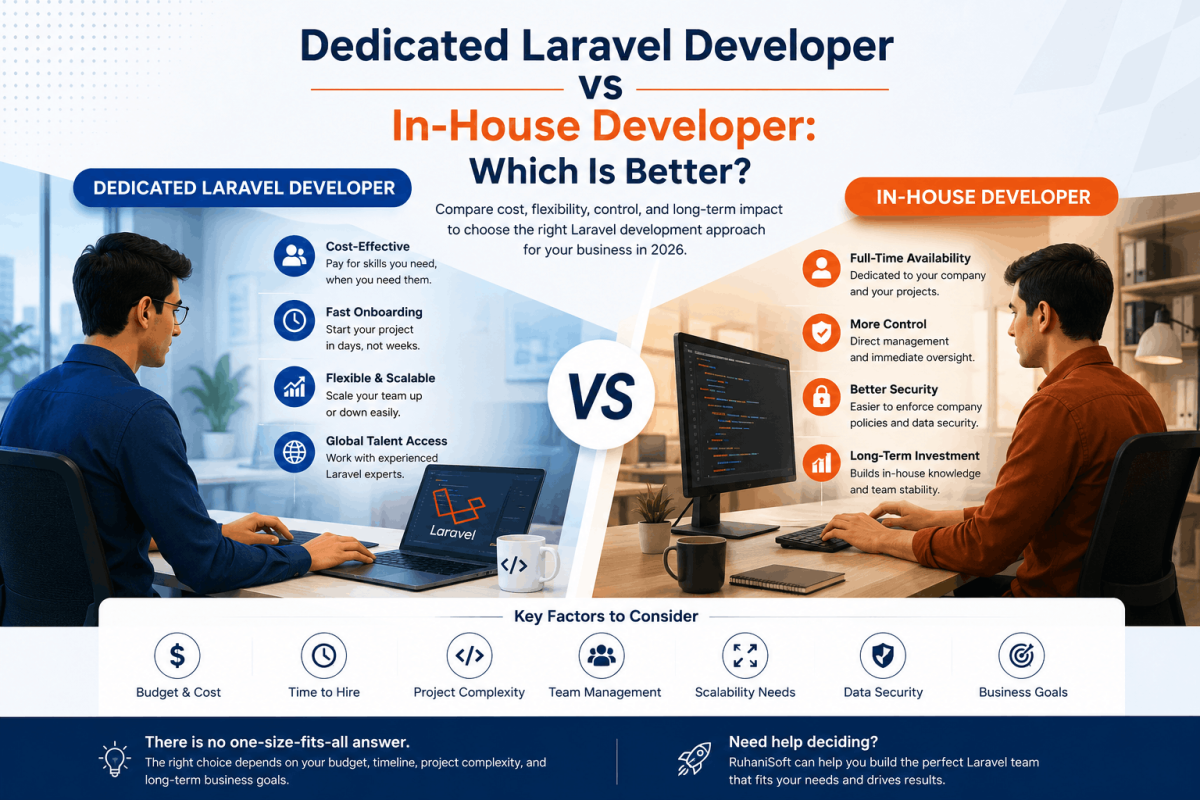
Dedicated Laravel Developer vs In-House Developer: Quick Comparison
| Factor | Dedicated Laravel Developer | In-House Developer |
|---|---|---|
| Hiring speed | Usually faster | Usually slower |
| Initial cost | Lower | Higher |
| Employment responsibilities | Handled by the provider | Handled by your company |
| Scalability | Easy to increase or reduce | More difficult |
| Direct control | Moderate to high | High |
| Local presence | Usually remote | Often local or internal |
| Long-term company knowledge | Depends on retention and documentation | Potentially strong |
| Access to additional specialists | Usually easier through an agency | Requires additional hiring |
| Replacement support | Often provided | Your company must recruit again |
| Administrative workload | Lower | Higher |
1. Hiring Speed
Dedicated Laravel Developer
Hiring a dedicated Laravel developer is often faster because the development company may already have experienced developers available.
You can usually review developer profiles, conduct interviews, discuss availability, and begin onboarding without running a long recruitment campaign.
This is useful when:
- Your project needs to begin quickly
- Your current team has too much work
- A developer has suddenly become unavailable
- You need specialist Laravel expertise
- You have a strict client delivery deadline
In-House Developer
Recruiting an in-house Laravel developer may require several stages:
- Writing the job description
- Publishing the vacancy
- Reviewing applications
- Conducting interviews
- Completing technical assessments
- Negotiating salary and benefits
- Waiting through the notice period
- Onboarding the employee
The process can take weeks or months, particularly in markets where experienced Laravel developers are in high demand.
Which Is Better?
A dedicated developer is usually better when speed is a priority. In-house hiring is more suitable when you can invest time in finding a long-term employee.
2. Cost of Hiring
Dedicated Laravel Developer
With a dedicated developer, you normally pay a monthly fee or agreed hourly rate. The provider handles the developer's salary, employment benefits, recruitment costs, equipment, office expenses, and administrative responsibilities.
This creates a more predictable operating cost.
You may also avoid expenses related to:
- Recruitment advertising
- Recruitment agency fees
- Health or employment benefits
- Office space
- Workstation equipment
- Employee insurance
- Paid leave
- Training programs
- Employment taxes
In-House Developer
The real cost of an in-house developer is higher than the monthly salary alone.
Your company must consider:
- Base salary
- Bonuses
- Paid holidays
- Benefits
- Recruitment expenses
- Equipment and software
- Office costs
- Training
- Management time
- Employee turnover
However, an in-house developer may provide strong long-term value when the company has continuous development needs for several years.
Which Is Better?
A dedicated Laravel developer is generally more cost-effective for startups, agencies, and companies that want flexibility. An in-house developer may be financially reasonable when there is stable, long-term work and the company can support full employment costs.
3. Flexibility and Scalability
Dedicated Laravel Developer
The dedicated model is designed for flexibility. You can begin with one developer and later add frontend developers, testers, designers, DevOps engineers, or additional Laravel developers.
You may also reduce the team when a major development phase is complete, depending on the contract terms.
This flexibility is valuable for:
- Startups with changing priorities
- Agencies managing several client projects
- Seasonal development workloads
- Products preparing for a major launch
- Companies testing a new business idea
In-House Developer
Scaling an internal team requires additional recruitment. Reducing the team can involve legal, financial, and cultural consequences.
Internal teams are therefore less flexible when development demand changes quickly.
Which Is Better?
The dedicated model is better for scalability. In-house development is more appropriate when the workload is stable and predictable.
4. Management and Control
Dedicated Laravel Developer
A dedicated developer can work directly with your project manager, technical lead, or product owner. You can assign tasks, review progress, attend sprint meetings, and communicate through your preferred project management tools.
However, the developer remains employed by the service provider. Some administrative matters may need to be coordinated through the provider's account manager or project manager.
In-House Developer
An in-house developer works completely within your company structure. You have direct control over:
- Working schedule
- Internal processes
- Project priorities
- Performance management
- Training
- Company responsibilities
- Long-term career development
This level of control can be valuable for highly sensitive projects or companies with complex internal processes.
Which Is Better?
An in-house developer provides greater organizational control. A dedicated developer still offers strong operational control when tasks, meetings, reporting, and responsibilities are clearly defined.
5. Access to Laravel Expertise
Dedicated Laravel Developer
A Laravel development company can match your project with a developer who has relevant technical experience.
You may request expertise in areas such as:
- Laravel SaaS architecture
- Multi-tenancy
- Laravel Livewire
- Inertia.js
- Vue.js or React
- REST APIs
- Laravel Sanctum
- Laravel Passport
- Laravel Horizon
- Redis and caching
- Queue processing
- Payment integrations
- Cloud deployment
- Automated testing
If the project later needs a different skill, the provider may be able to add another specialist without requiring you to recruit independently.
In-House Developer
An in-house developer may have deep knowledge of your product but cannot be expected to specialize in every technical area.
You may still need to hire contractors or consultants for:
- DevOps
- Security audits
- Complex database optimization
- Frontend architecture
- Mobile application integration
- Advanced cloud infrastructure
Which Is Better?
A dedicated developer is often better for accessing specialized Laravel expertise. An in-house developer is better for developing deep internal product knowledge over time.
6. Communication and Collaboration
Dedicated Laravel Developer
Dedicated developers usually work remotely, which means communication must be structured.
A reliable process should include:
- Daily or scheduled updates
- Weekly sprint meetings
- Written task requirements
- Defined response times
- Overlapping working hours
- Progress demonstrations
- Documented technical decisions
Tools such as Slack, Microsoft Teams, Jira, ClickUp, Trello, Linear, GitHub, and Google Meet can support remote collaboration.
In-House Developer
An in-house developer may communicate more easily with internal departments. Informal conversations can happen quickly, and the developer may gain a deeper understanding of daily business operations.
However, physical proximity does not automatically create good communication. Internal teams still need documented requirements, task ownership, and clear project priorities.
Which Is Better?
An in-house developer may have an advantage for frequent internal collaboration. A dedicated developer can communicate effectively when the company uses a structured remote working process.
7. Company and Product Knowledge
Dedicated Laravel Developer
A dedicated developer can develop strong product knowledge when assigned to your application for a long period.
The risk arises when documentation is weak or the developer is frequently replaced. Important technical knowledge may remain with one person instead of being stored in project documentation.
In-House Developer
An in-house employee may better understand:
- Company culture
- Internal workflows
- Customer expectations
- Sales processes
- Operational challenges
- Long-term business goals
This knowledge can improve product decisions and reduce the need to repeatedly explain business context.
Which Is Better?
An in-house developer often has a natural advantage in long-term organizational knowledge. A dedicated developer can achieve similar product understanding through long-term engagement, regular communication, and proper onboarding.
8. Developer Availability and Continuity
Dedicated Laravel Developer
A dependable outsourcing company should have a process for handling developer illness, resignation, or unavailability.
The provider may offer:
- Temporary replacement
- Permanent replacement
- Knowledge transfer
- Technical supervision
- Backup support from other team members
This reduces the risk of your project stopping completely when one developer becomes unavailable.
In-House Developer
If an in-house developer resigns, your company must recruit and train a replacement. The process may take several months.
The risk is higher when only one employee understands the application architecture.
Which Is Better?
A dedicated developer from an established agency may provide better replacement support. Both models require documentation and knowledge sharing to reduce dependency on one person.
9. Security and Confidentiality
Dedicated Laravel Developer
Remote development can be secure when the correct controls are in place.
Your company should use:
- Non-disclosure agreements
- Role-based repository access
- Separate development and production environments
- Password management tools
- Two-factor authentication
- VPN access when required
- Access logs
- Regular permission reviews
The contract should clearly define intellectual property ownership, confidentiality, data handling, and access removal procedures.
In-House Developer
Internal employment can make it easier to apply company security policies, but it does not remove security risks.
In-house employees should also receive only the access required for their responsibilities.
Which Is Better?
An in-house developer may be preferable for highly regulated or sensitive systems that require strict local control. For most commercial Laravel projects, a dedicated developer can work securely with proper contracts and access management.
10. Long-Term Maintenance
Dedicated Laravel Developer
A dedicated developer can continue supporting the application after launch through:
- Bug fixing
- Security updates
- Laravel upgrades
- Performance monitoring
- New feature development
- Database optimization
- Server support
- Third-party API maintenance
The engagement can be adjusted according to the amount of ongoing work.
In-House Developer
An internal developer is immediately available for maintenance, user support, urgent business changes, and ongoing feature planning.
This can be valuable when the Laravel application is central to daily operations.
Which Is Better?
An in-house developer may be better for systems requiring continuous internal support. A dedicated developer is often better when maintenance needs change from month to month.
When Should You Hire a Dedicated Laravel Developer?
A dedicated Laravel developer is a strong option when:
- You need to begin development quickly
- You want to reduce recruitment costs
- You need specialized Laravel knowledge
- Your project requirements may change
- You want to scale the team gradually
- You already have a product manager or technical lead
- You need additional capacity for an internal team
- You are building an MVP
- You are an agency with ongoing client work
- You need temporary or long-term Laravel support
This model is especially useful for startups and small businesses that need professional development capability without building a complete internal department.
When Should You Hire an In-House Laravel Developer?
An in-house developer may be the better choice when:
- Your company has continuous development work
- The application is central to daily operations
- You need close collaboration with internal teams
- You have the budget for salary and employment costs
- You can manage recruitment and employee retention
- The project contains highly sensitive information
- You want to build a permanent internal engineering team
- You need immediate involvement in business decisions
Companies with mature product management and stable revenue may benefit from investing in an internal development team.
Can You Combine Both Models?
You do not always have to choose only one model. Many companies use a hybrid structure.
For example, you may have:
- An in-house technical lead
- One internal product manager
- Two dedicated Laravel developers
- A remote quality assurance engineer
- Part-time DevOps support
This approach allows your company to maintain internal control while accessing external technical capacity.
A hybrid team is often effective for growing SaaS businesses, digital agencies, and companies modernizing large Laravel applications.
How to Evaluate a Dedicated Laravel Developer
Before hiring a dedicated developer, evaluate both technical ability and communication skills.
Review Relevant Experience
Ask for examples of Laravel applications similar to your project. Focus on the technical problems solved rather than only the visual design.
Conduct a Technical Interview
Discuss topics such as:
- Laravel architecture
- Database relationships
- Authentication and authorization
- Queue processing
- Caching
- API security
- Testing
- Performance optimization
- Deployment
Review Sample Code
Look for readable structure, appropriate validation, secure authorization, consistent naming, useful tests, and maintainable business logic.
Assess Communication
The developer should be able to explain technical decisions, identify risks, ask useful questions, and report progress clearly.
Start With a Trial Period
A short paid trial can help you evaluate delivery quality before committing to a longer engagement.
How to Evaluate an In-House Laravel Candidate
When recruiting an internal developer, evaluate more than Laravel syntax.
Consider:
- Technical ability
- Problem-solving skills
- Communication
- Understanding of business requirements
- Ability to work independently
- Interest in the company's product
- Long-term career expectations
- Ability to collaborate with non-technical teams
A strong in-house employee should contribute to product decisions and technical planning, not only complete assigned coding tasks.
Common Mistakes to Avoid
Comparing Salary With an Outsourcing Fee Directly
An employee's salary does not include the complete cost of recruitment, benefits, equipment, taxes, management, and turnover.
Hiring One Developer for Every Technical Responsibility
A Laravel developer may not also be an expert designer, DevOps engineer, tester, security specialist, and frontend architect.
Ignoring Documentation
Both dedicated and in-house developers should document setup instructions, architecture decisions, deployment processes, and important business logic.
Choosing Only by Hourly Rate
A low hourly rate does not guarantee lower total project cost. Poor code quality and repeated rework can make a cheap developer more expensive.
Starting Without Clear Ownership
Every project needs someone responsible for requirements, priorities, approvals, and feedback.
Giving Developers Unrestricted Production Access
Use role-based access and separate environments regardless of the hiring model.
Decision Checklist
Ask the following questions before making your decision:
- How quickly do we need the developer?
- Is the workload permanent or temporary?
- Can we support full employment costs?
- Do we have an internal technical manager?
- Do we need specialist Laravel expertise?
- How frequently will the team size change?
- How sensitive is the project data?
- How important is local presence?
- Do we have a structured remote working process?
- Will the developer need access to other specialists?
- Can we manage recruitment and retention?
- What support will be required after launch?
How RuhaniSoft Supports Dedicated Laravel Development
RuhaniSoft provides dedicated Laravel and PHP development support for startups, digital agencies, software companies, and growing businesses.
Depending on the project, clients can work with dedicated developers for:
- Laravel SaaS development
- Custom business applications
- Client portals
- API development
- Payment integrations
- Admin dashboards
- Legacy application improvement
- Laravel upgrades
- Performance optimization
- Bug fixing
- Ongoing maintenance
The dedicated model allows clients to work directly with assigned developers while using clear tasks, sprint planning, progress reporting, and regular project reviews.
RuhaniSoft can also support companies that already have an internal team but need additional Laravel capacity for specific projects or development periods.
Which Option Is Better?
There is no single answer that applies to every company.
A dedicated Laravel developer is usually better when you need faster hiring, lower initial costs, flexible scaling, and access to specialized expertise.
An in-house developer is usually better when you need maximum organizational control, continuous internal collaboration, and a permanent engineering presence.
For many startups and growing companies, a dedicated developer provides the most practical balance between cost, expertise, and flexibility. For established companies with stable development requirements, an in-house developer may provide stronger long-term integration.
A hybrid model can offer the benefits of both approaches by combining internal product ownership with external Laravel expertise.
Businesses evaluating either option should focus on total cost, technical quality, continuity, communication, security, and long-term product needs rather than choosing based only on location or hourly rate.