
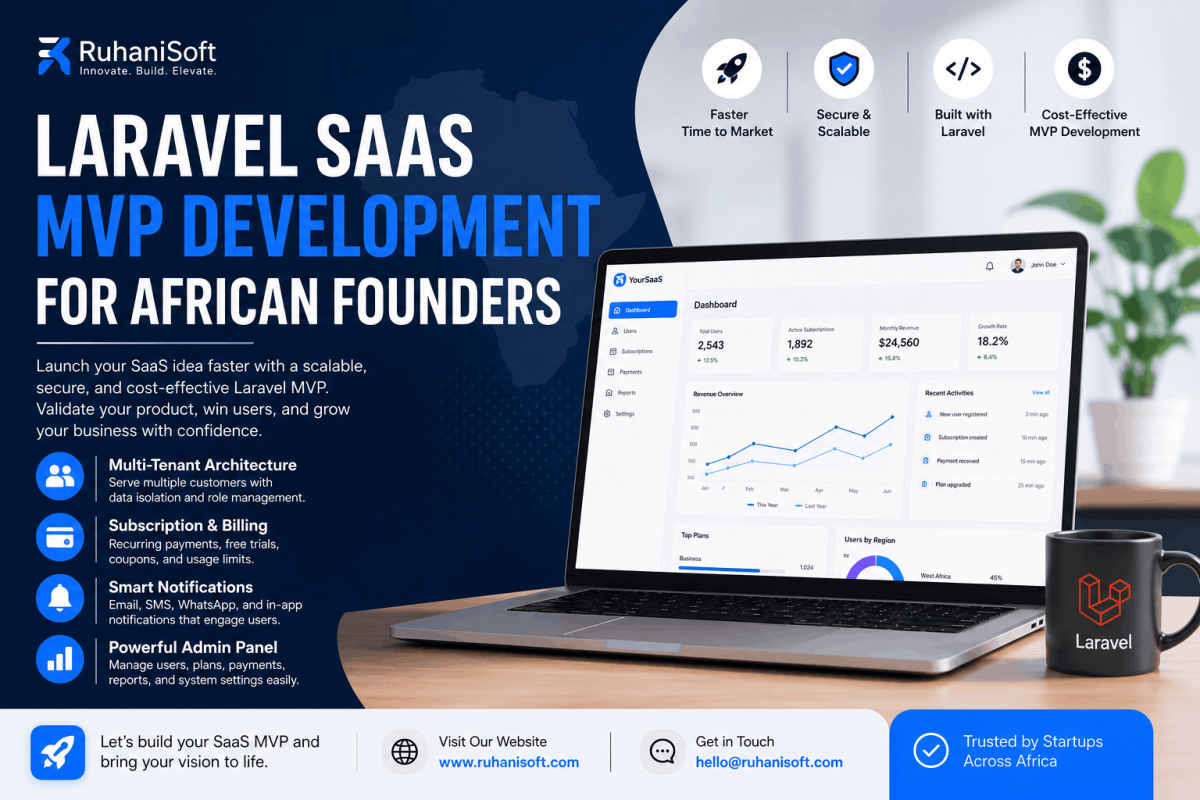
Laravel SaaS MVP Development for African Founders
African founders are building software products for some of the fastest-growing digital markets in the world. From fintech and logistics to education, healthcare, agriculture, property management, and business automation, there is growing demand for practical SaaS platforms designed around local problems.
However, launching a SaaS product is not only about having a strong idea. Founders also need to make decisions about product scope, development cost, technical architecture, security, user experience, hosting, payments, and long-term scalability.
This is where Laravel SaaS MVP development becomes valuable.
Laravel allows founders to build secure, flexible, and scalable SaaS minimum viable products without the cost and complexity of developing a large platform from the beginning. With an experienced offshore development partner such as RuhaniSoft, African founders can move from idea to working product through a structured and practical development process.
What Is a SaaS MVP?
A SaaS MVP is the first usable version of a software-as-a-service product. It includes the core features required to solve a specific customer problem and test whether users are willing to adopt or pay for the solution.
The purpose of an MVP is not to build every possible feature. The purpose is to validate the product with real users before investing heavily in full-scale development.
A typical SaaS MVP may include:
- User registration and login
- Account or company management
- Role and permission controls
- A customer dashboard
- One or two core business workflows
- Subscription or payment functionality
- Email notifications
- Basic reporting
- An administration panel
For African founders, this approach can reduce financial risk while creating a real product that can be demonstrated to investors, partners, customers, and early adopters.
Why Laravel Is a Strong Choice for SaaS MVP Development
Laravel is one of the most widely used PHP frameworks for building modern web applications. It offers a mature ecosystem, strong security tools, clean code structure, and a large developer community.
These qualities make Laravel particularly suitable for SaaS MVP development.
1. Faster Development
Laravel includes many built-in features that development teams would otherwise need to create manually. These include authentication, database management, routing, queues, notifications, validation, background jobs, and API support.
This reduces development time and allows founders to launch an MVP faster.
2. Lower Initial Development Cost
Laravel is open source and does not require expensive software licensing. It also has a large talent pool, which helps founders access experienced developers at competitive rates.
For early-stage African startups, lower initial development cost can preserve capital for marketing, customer acquisition, compliance, and product testing.
3. Scalable Architecture
A Laravel MVP can start small and expand as the startup gains users. Developers can add new modules, integrations, background services, mobile APIs, analytics, billing systems, and automation tools over time.
This means the MVP does not need to be replaced when the business grows, provided the initial architecture is planned correctly.
4. Strong Security Features
Laravel includes protection against common web application threats such as cross-site request forgery, SQL injection, insecure password storage, and unauthorized access.
For SaaS products that handle customer records, financial data, employee information, or private business documents, security should be part of the MVP from the beginning.
5. Flexible Integration Options
African SaaS products often need to connect with payment gateways, messaging platforms, accounting tools, mobile money services, email providers, and local business systems.
Laravel provides a strong foundation for building these integrations through APIs, webhooks, queues, and scheduled tasks.
Common SaaS Ideas for African Founders
Laravel can support a wide range of SaaS business models. The best opportunities often come from solving operational problems that businesses currently manage through spreadsheets, messaging apps, paper documents, or disconnected tools.
Fintech and Payment Operations
Founders can build SaaS products for invoicing, collections, expense tracking, agent management, recurring billing, loan administration, reconciliation, and financial reporting.
These products may require integration with regional payment gateways, banks, or mobile money providers.
Logistics and Delivery Management
Laravel can power logistics platforms with order tracking, driver assignment, route management, delivery confirmation, customer notifications, fleet management, and operational reporting.
School and Education Management
Education SaaS products can include student enrollment, attendance, results, fees, parent portals, teacher dashboards, course materials, and communication features.
Healthcare Administration
Healthcare-focused MVPs can support appointment scheduling, patient records, clinic operations, pharmacy management, billing, reminders, and reporting.
Agriculture and Supply Chain Platforms
Laravel can be used to build platforms for farmer registration, inventory tracking, produce collection, supplier management, pricing, logistics, and buyer coordination.
Property and Rental Management
Founders can launch SaaS products for tenant management, rent collection, property maintenance, lease tracking, agent management, and owner reporting.
SME Business Management
Many small and medium-sized businesses need affordable tools for CRM, sales tracking, staff management, quotations, invoicing, inventory, and customer support.
A focused SaaS product can serve a specific industry instead of competing with large general-purpose platforms.
What Should Be Included in a Laravel SaaS MVP?
The exact feature list depends on the business model, but most SaaS MVPs require several foundational components.
User Authentication
Users should be able to register, log in, reset passwords, verify email addresses, and manage their profiles securely.
Multi-Tenant Account Structure
Many SaaS products serve multiple companies or organizations. Each customer account may need separate users, data, permissions, and subscription details.
The development team must choose the correct multi-tenancy approach based on security, expected growth, reporting needs, and infrastructure budget.
Roles and Permissions
A SaaS platform may include owners, managers, employees, customers, agents, accountants, or administrators. Each role should only access the information and actions relevant to that user.
Core Product Workflow
The MVP should focus on the main workflow that delivers value. For example, a delivery management SaaS may focus first on order creation, driver assignment, and delivery status tracking.
Secondary features can be added after the core workflow is validated.
Subscription and Billing
The platform may require monthly plans, annual plans, free trials, coupons, usage limits, or manual subscription approval.
For African markets, billing may need to support regional payment options in addition to international card payments.
Administration Panel
The founder or operations team should be able to manage users, customer accounts, plans, subscriptions, settings, support requests, and important platform data.
Notifications
Email, SMS, WhatsApp, push, or in-app notifications may be required depending on the product and target market.
Basic Analytics and Reports
Founders need visibility into user activity, subscriptions, revenue, usage, failed payments, and customer growth. The first version does not need complex business intelligence, but it should provide basic operational reporting.
How to Keep the MVP Scope Under Control
One of the biggest reasons SaaS projects become expensive is uncontrolled scope. Founders often try to include every possible feature in the first release.
A better approach is to classify features into three groups:
- Essential for launch
- Useful after validation
- Future expansion
The launch version should only include features that are necessary for users to complete the main business process.
For example, an inventory SaaS MVP may require product management, stock movement, supplier records, and basic reports. It may not initially need artificial intelligence forecasting, multiple warehouse automation, advanced accounting, or complex third-party integrations.
RuhaniSoft helps founders convert broad product ideas into structured development phases. This reduces unnecessary cost and makes delivery easier to manage.
Typical Laravel SaaS MVP Development Process
A structured process helps prevent confusion, delays, and rework.
Step 1: Product Discovery
The development team reviews the business problem, target users, pricing model, competitors, required workflows, and technical constraints.
This stage helps define what the MVP must achieve.
Step 2: Feature Prioritization
Features are divided into essential, secondary, and future items. The MVP backlog is then prepared based on business value and development complexity.
Step 3: Technical Planning
The team defines the Laravel architecture, database structure, multi-tenancy model, API requirements, hosting setup, security controls, and third-party integrations.
Step 4: UI and UX Design
Wireframes and interface designs are created for important screens. The goal is to keep the product simple enough for early users to understand without extensive training.
Step 5: Sprint-Based Development
The product is developed in short sprints. Each sprint delivers a working group of features for review.
This allows founders to provide feedback throughout the project instead of waiting until the end.
Step 6: Testing
The team tests workflows, permissions, payments, forms, notifications, APIs, mobile responsiveness, and error handling.
Step 7: Deployment
The application is deployed to a production server, configured with backups, monitoring, email services, queues, scheduled tasks, and security settings.
Step 8: Post-Launch Support
After launch, the team reviews user feedback, fixes issues, improves usability, and plans the next development phase.
Cost Factors for Laravel SaaS MVP Development
The cost of building a Laravel SaaS MVP depends on several factors.
- Number of user roles
- Complexity of the core workflow
- Multi-tenancy requirements
- Payment gateway integrations
- Mobile application or API requirements
- Custom UI design
- Reporting complexity
- Third-party integrations
- Data migration requirements
- Security and compliance needs
A simple internal SaaS MVP may require only a few core modules, while a marketplace, fintech platform, or healthcare system may need significantly more planning and development.
Founders should avoid selecting a development partner based only on the lowest quote. Poor architecture, weak security, missing documentation, and incomplete testing can increase long-term costs.
Should African Founders Hire Locally or Offshore?
Both local and offshore development models can work. The right option depends on budget, technical requirements, hiring availability, and how quickly the product needs to launch.
Hiring a full internal team may require recruiting backend developers, frontend developers, designers, QA engineers, DevOps specialists, and a technical lead. This can be difficult for an early-stage startup.
An offshore Laravel development company can provide access to an existing team without the cost of building the entire department internally.
The advantages may include:
- Lower hiring overhead
- Access to specialized Laravel experience
- Faster project startup
- Flexible engagement models
- Support from design, development, QA, and DevOps specialists
- Easier scaling after product validation
The main requirement is choosing a partner with transparent communication, structured project management, clear ownership, and reliable post-launch support.
Why African Founders Choose RuhaniSoft
RuhaniSoft provides Laravel and offshore software development services for founders, startups, agencies, and growing companies.
For African founders, RuhaniSoft can support the complete MVP journey, from early product planning to deployment and long-term improvement.
Laravel-Focused Development Experience
RuhaniSoft works with Laravel applications, SaaS platforms, business management systems, APIs, admin panels, and custom web applications.
This focus helps the team identify common architectural, security, and scalability issues before they become expensive problems.
Practical MVP Planning
The team helps founders reduce large ideas into clear development phases. This keeps the first release focused on validation instead of unnecessary complexity.
Transparent Sprint Delivery
Projects can be delivered through weekly sprints with regular updates, demonstrations, testing, and feedback.
Flexible Team Models
Founders may choose fixed-scope development, dedicated Laravel developers, or an extended offshore development team depending on their requirements.
Support for Long-Term Product Growth
After the MVP launches, RuhaniSoft can help add new modules, improve performance, build APIs, support mobile applications, integrate payment systems, strengthen security, and scale infrastructure.
Questions to Ask Before Hiring a Laravel MVP Development Company
Before selecting a development partner, founders should ask several important questions.
- Have you built SaaS platforms with Laravel?
- How will you define and control the MVP scope?
- How will multi-tenancy be implemented?
- How will user roles and data separation be secured?
- How often will I receive updates?
- Will I own the full source code?
- Will the project include documentation?
- How will testing be handled?
- What happens after the MVP launches?
- Can the application scale without a complete rewrite?
The answers should be specific and connected to the founder's product, not generic sales statements.
Common Mistakes to Avoid
Building Too Many Features
Adding too many features increases cost, delays launch, and makes user feedback harder to interpret.
Ignoring Payment Challenges
Founders should confirm which payment methods their target customers can actually use. The billing system should reflect local customer behavior.
Skipping User Research
Founders should speak with potential users before development and during testing. Assumptions should be validated early.
Choosing Weak Multi-Tenant Architecture
Poor data separation can create serious security and maintenance problems. Multi-tenancy should be designed carefully.
Launching Without Analytics
The MVP should track important user actions so founders can understand adoption, engagement, and conversion.
Ignoring Maintenance Costs
Hosting, monitoring, backups, security updates, customer support, and ongoing development should be included in the business plan.
How Long Does Laravel SaaS MVP Development Take?
A focused MVP may take several weeks, while a more complex platform may require several months.
The timeline depends on feature scope, design complexity, integration requirements, feedback speed, and testing needs.
A realistic schedule is more useful than an aggressive promise. Founders should prefer a team that explains the development phases clearly and identifies risks early.
Preparing the MVP for Future Growth
Even though an MVP should remain focused, it should not be built carelessly.
The initial product should include:
- Clean and maintainable Laravel code
- A structured database
- Secure authentication and permissions
- API-ready architecture where necessary
- Environment-based configuration
- Automated backups
- Error logging and monitoring
- Basic technical documentation
- A defined deployment process
These foundations make it easier to add features, onboard new developers, improve performance, and support more customers.
Start Your Laravel SaaS MVP with RuhaniSoft
African founders do not need to begin with a large engineering team or a fully developed enterprise platform. A focused Laravel SaaS MVP can validate the business idea, attract early customers, support investor discussions, and create a clear path for future growth.
The most important step is turning the idea into a realistic product scope with the right technical foundation.
RuhaniSoft helps founders plan, design, build, test, and launch Laravel SaaS products through flexible offshore development models.
Visit ruhanisoft.com to discuss your SaaS MVP idea and explore a development approach based on your market, budget, and growth goals.